


What Europeans think about solar radiation modification
Introduction
Any large-scale deployment of SRM would carry planetary-scale effects, spread unevenly across regions, and would bear consequences for generations to come. This set of technologies is drawing growing attention as climate risks intensify, but the discussion has so far stayed largely within scientific and policy circles.
Decisions about SRM’s future will affect everyone. As the findings below show, most citizens currently know very little about it and have had little chance to weigh in. Closing that knowledge gap and taking citizens’ concerns seriously are central to guiding any future research and to building responsible governance.
We evaluated a set of recent multi-country surveys of European publics to understand where people actually stand. Drawing on studies conducted across Austria, Germany, Italy, the UK, Poland, Switzerland, Spain and Norway, this brief looks at how familiar Europeans are with SRM, how they react when first introduced to it, the conditions under which they support or oppose further research, and the concerns that shape their views.
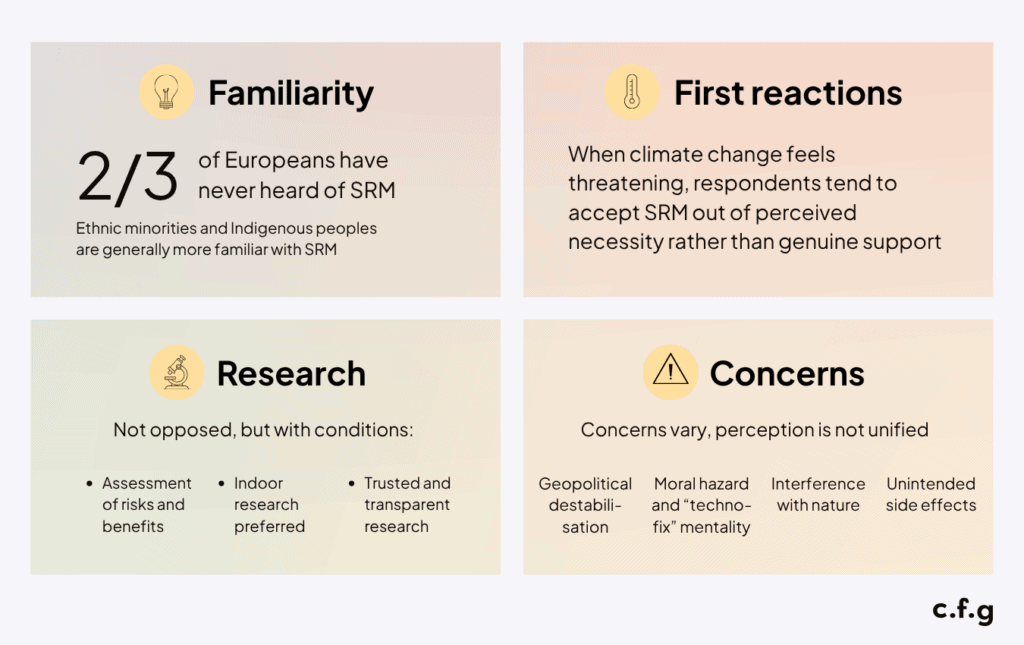
How familiar are European citizens with Solar Radiation Modification (SRM)?
Few Europeans know what SRM is. A majority of Europeans have never heard of SRM or stratospheric aerosol injection (SAI). Surveys conducted in Austria, Germany, Italy, the UK and Norway illustrate that as much as two-thirds of respondents are not aware of the technology[1],[2]. Furthermore, among other climate intervention technologies, SRM is the one with which they are least familiar.
However, a survey distributed across 14 European countries to self-identified ethnic minorities and Indigenous peoples found that they had greater familiarity with these technologies than all of the other respondents[3].
How do Europeans react to learning about SRM?
Initial reactions tend to vary depending on how directly people feel affected by climate change. Openness to SRM is closely linked to the threat of climate change and personal experience of its effects[4] [5]. Where climate change is seen as immediate and threatening, acceptance[6] of potential implementation and use of SRM tends to increase, largely driven by a sense of necessity rather than active support[7].
Europeans in parts of Northern Europe often express greater scepticism[8], reflecting a perception that climate change, while serious, is not yet as disruptive for them personally[9],[10]. By contrast, respondents in Germany who found climate change to be a serious problem expressed more openness to SRM[11].
Support for climate intervention technologies, particularly SRM, correlates more strongly within younger populations. This is true across the globe, including in European countries[12].
Are Europeans supportive of SRM research?
European publics are generally not opposed to SRM research, but with conditions. Participants in the surveys favour further study and an assessment of environmental, social, and geopolitical risks and benefits[13]. Additionally, most respondents favour independent review mechanisms and agreed rules rather than moratoria[14].
There is support for public funding of research — though stronger in the Global South — provided it is transparent and conducted by trusted scientific institutions[15] [16]. Universities and independent experts are typically the most trusted actors, and participants expect clear communication to the public and disclosure of conflicts of interest[17].
What do Europeans think about testing?
Many draw a clear line between indoor and outdoor research. While modelling and indoor research are often seen as acceptable, outdoor experiments — especially at larger scales — are viewed as more sensitive, and, if conducted, should be preceded by international agreement and oversight given potential transboundary effects[18].
Although some groups, including members of Indigenous or ethnic minority communities, express greater openness to small-scale trials[19], others have expressed clear opposition to testing, like the Sámi people in Sweden[20]. At the same time, some participants doubted whether small-scale research can meaningfully predict planetary-scale effects and expressed concern about unforeseen side effects and overreliance on modelling[21].
What concerns dominate European public attitudes towards SRM?
Alongside the potential benefits of SRM (e.g., the capacity to lower temperatures[22] [23] and possibly support food security[24]), respondents also raised several concerns:
- Geopolitical concerns: Uneven regional impacts, unequal capabilities[25], and the possibility of unilateral deployment are seen as potential sources of conflict [26].
- Ethical concerns: Some worry that politicians or corporations might use SRM as a justification to delay emissions reduction (moral hazard or “techno-fix” illusion)[27]. Aversion to “tampering with nature” is also a strong reason for opposition to SRM in surveys across Europe[28][29], although others frame it as a possible means of protecting natural systems in the face of a climate emergency. In this sense, reactions often depend on whether nature is viewed as something that must not be interfered with, or as something already damaged that may require active protection[30].
- Scientific concerns: Some feared unintended side effects and effects on precipitation patterns, agriculture[31] and ecosystems[32][33].
[1] Sovacool, B.K., Baum, C.M., Fritz, L., Low, S. Social attitudes towards climate interventions: Are European publics uninformed about carbon removal and solar radiation management? Environmental Science & Policy, 2025. Surveys show that in Austria, 75% of respondents had never heard of SAI and over 65% of the respondents in the UK had never heard of SAI.
[2] UKRI, Science Wise, Public views on SRM research and potential deployment, June 2026. The survey of 52 participants from the UK noted that most had not heard of SRM.
[3] Sovacool, B.K., Baum, C.M., Fritz, L., Minority groups, Indigenousness and Indigeneity, and place in social perceptions of future climate interventions. World Development, 2024. The survey was distributed in 30 countries, including 14 European countries. In the European countries sampled, 3% of respondents self-identified as ethnic minority or Indigenous peoples.
[4] Ibid.
[5] Braun, C., Merk, C., Pönitzsch, G., Rehdanz, K., Schmidt, U., Public perception of climate engineering and carbon capture and storage in Germany: Survey results, Climate Policy, 2018
[6] Contzen, N., Perlaviciute, G., Steg, L., et al., Public opinion about solar radiation management: A cross-cultural study in 20 countries around the world, Climatic Change, 2024
[7] Milani A., Dessi F., Bonaiuto M. Why do people embrace renewable and sustainable energy technologies for mitigation and geoengineering for adaptation? Explore norms, emotions, and attitudes driving social acceptance, Journal of Environmental Psychology, 2026
[8] Fritz, L., Baum, C.M., Brutschin, E., Low, S., Sovacool, B.K. Climate beliefs, climate technologies and transformation pathways: Contextualizing public perceptions in 22 countries, Global Environmental Change, 2024. See also Sovacool et al, 2025 in which Austrian and German respondents express great scepticism towards SRM.
[9] Low, S., Fritz, L., Baum, C.M., Sovacool, B.K. Public perceptions on solar geoengineering from focus groups in 22 countries, Communications Earth & Environment, 2024
[10] Tvinnereim E., Lægreid O.M., Liu X., Shaw D., Borick C., Lachapelle E., Climate change risk perceptions and the problem of scale: evidence from cross-national survey experiments, Environmental Politics, 2020
[11] Braun, et al. Climate Policy. They define acceptance based on the level of agreement with the question “We should use SRM to counteract climate change”.
[12] Baum, C.M., Fritz, L., Low, S., Sovacool, B. K. Public perceptions and support of climate intervention technologies across the Global North and Global South Nature Communications, 2024
[13] See Fritz, L., Losi, L., Baum, C.M., Low, S., Sovacool, B.K. Between inflated expectations and inherent distrust: How publics see the role of experts in governing climate intervention technologies, Environmental Science & Policy, 2025 ; Low et al., Communications Earth & Environment and Sovacool, et al., Environmental Science & Policy; UKRI and Science Wise, Public views on SRM research and potential deployment.
Regarding the latter study, out of 52 participants from the UK, many participants expressed “support for SRM research on condition that there are safeguards and a strong ethical framework”. Survey participants then developed SRM research principles including to do no harm to people and the environment; avoid distracting from reducing greenhouse gas emissions; be globally coordinated and collaborative; for the public to be informed, educated, and engaged in SRM research and decision-making; prioritise the public good and future generations and ensure transparency, integrity, and accountability.
[14] Bellamy, et al. Global Environmental Change
[15] Baum, et al. Nature Communications. Figure 6, 60.85% from the Global South and 44.52% from the Global North supporting national funding for public and private R&D.
[16] UKRI and Science Wise, Public views on SRM research and potential deployment
[17] Fritz et al., Environmental Science & Policy
[18] Bellamy, R., Lezaun, J., Palmer, J. Public perceptions of geoengineering research governance: An experimental deliberative approach. Global Environmental Change, 2017; UKRI and Science Wise, Public views on SRM research and potential deployment. The survey reported mixed views on research moving from computer modelling to outdoor research, and much less support of large-scale experiments.
[19] Sovacool, et al. World Development
[20] Baum, et al. Nature Communications
[21] Macnaghten, P., Szerszynski, B. Living the global social experiment: An analysis of public discourse on solar radiation management and its implications for governance. Global Environmental Change, 2013
[22] Sovacool, et al. Environmental Science & Policy
[23] Low, et al. Communications Earth & Environment
[24] Ibid
[25] Sovacool, et al. Environmental Science & Policy
[26] Low, et al. Communications Earth & Environment
[27] Fritz, L., Baum, C.M., Brutschin, E., Low, S., Sovacool, B.K. Climate beliefs, climate technologies and transformation pathways: Contextualizing public perceptions in 22 countries, Global Environmental Change, 2024
[28] Corner, A., Parkhill, K., Pidgeon, N., Vaughan, N.E. Messing with nature? Exploring public perceptions of geoengineering in the UK, Global Environmental Change,2013
[29] Braun, et al. Climate Policy
[30] Corner, et al., Global Environmental Change
[31] UKRI and Science Wise, Public views on SRM research and potential deployment
[32] Sovacool, et al. Environmental Science & Policy
[33] Low, et al. Communications Earth & Environment