


Strength in small numbers
Over the past year or so, the Centre for Future Generations has joined a wave of new coalitions focused on connecting the dots between tech policy, geopolitics, and threats to European democracy.
Last year’s Franco-German Tech Sovereignty Summit saw the launch of the European Network for Technological Resilience and Sovereignty (ETRS), an academic, think-tank and civil-society group coordinated by Bertelsmann Stiftung. We were there at that event, and we now contribute to its work on public engagement. In March, we became one of the founding members of the European Techno-Democracy Coalition in Leuven, where companies like Proton and Mastodon sit alongside academics from KU Leuven and digital rights groups like Tactical Tech. Through it, we joined one of the stakeholder workshops behind the European Partnership for Democracy’s new report, Democratic by Design, on who really governs the platforms we depend on. And in May, the Democratic Tech Alliance launched at the European Parliament.
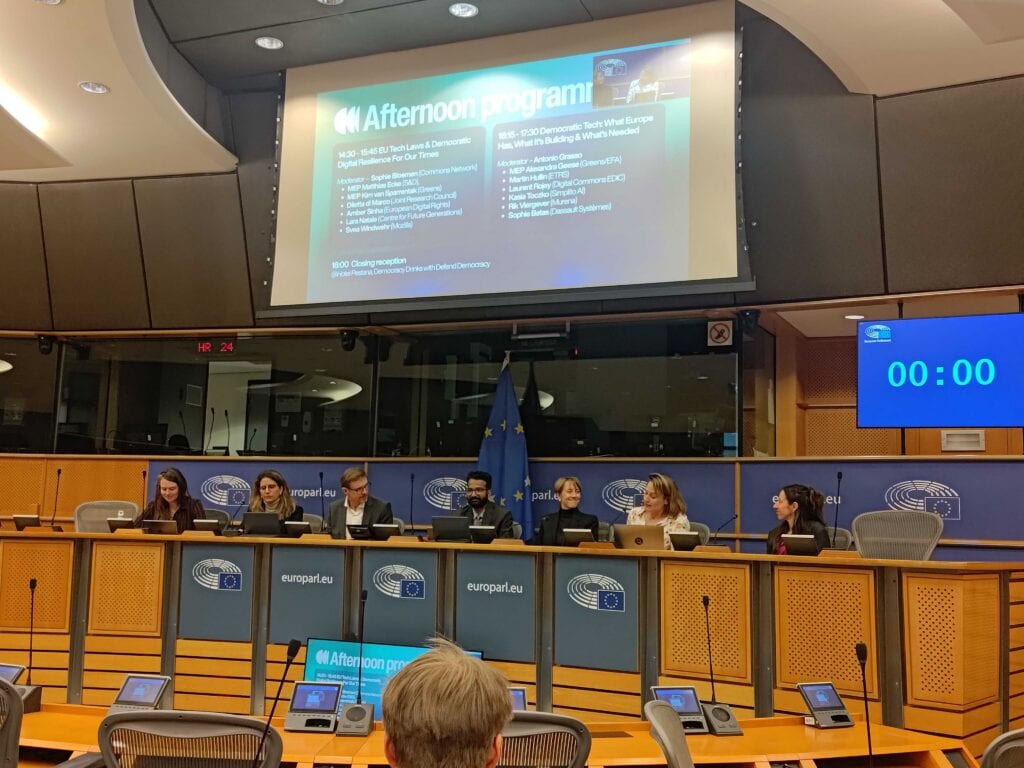
Lara spoke on the Alliance’s opening panel, alongside the MEPs Matthias Ecke and Kim van Sparrentak, as well as speakers from the Joint Research Centre, the digital rights group European Digital Rights, and Mozilla. This month the Alliance welcomed eight new organisations at once, us among them, alongside groups as different as Internet Archive Europe and Open Markets Institute Europe.
From the outside, a wave of new coalitions looks like a healthy, crowded field, but it is closer to the opposite. These coalitions keep circling the same problem: Europe actually has very few independent organisations working on technology policy when you compare it to the scale of the challenge.
A thin bench
Compared with climate, health or trade, where decades of philanthropic investment have built deep, well-funded benches of expertise, tech policy is a young and under-resourced field. The organisations in it do serious work, but most have had to go deep on a single technology, or a single tradition – consumer protection, human rights, competition – because no one has been funded to do more. Few can afford to work across technologies, or on the longer horizons where governance problems first take shape. And the questions keep getting harder and wider: enforcement, sovereignty, democratic resilience, and the effect of AI on how people work and think.
We often tell policymakers that technological change happens faster than our institutions are able to respond to – but it’s more than that. Emerging technologies do not respect silos. They defy the traditional architecture of policy – cutting across ministries, departments, and agencies. The power and perils of innovation demand new ways of working for our institutions, but that same lesson applies to the burgeoning group of think tanks, activists and nonprofit groups looking to help policymakers unpick this incredibly difficult set of problems. It is helpful to step back and assess the landscape we are operating in.
Let’s start with the money. Corporate Europe Observatory and LobbyControl, drawing on the EU’s Transparency Register, put the digital industry’s annual spend on lobbying the European Union at a record €151 million, a figure they call a conservative estimate. In their 2026 corporate lobby league, tech is the biggest-spending sector of all, ahead of energy, chemicals and finance. By contrast, the European AI & Society Fund, the largest dedicated funder of work on tech governance in Europe, put around €4 million into the field in 2025, and €13.6 million in total since 2020. The industry spends more lobbying Brussels in a single month than the Fund put into the field in a year.
Nor is the wider picture improving. The European Parliament reported in 2026 that funding for civil society across the Union remains limited and fragmented, and that civic space is shrinking. Technology governance is a small, late-arriving corner of a sector now contracting around it.
Other causes are also experiencing real financial constraints, but the funding gap is of a different order: climate, health and development each have well-established pools of philanthropic funding in the billions, while independent work on technology governance has generally run ahead of the funder landscape.
That gap is part of why these coalitions keep drawing us in. CFG works across advanced AI, biotech, climate interventions, and neurotech; we focus on using foresight to spot governance problems before they reach Commissioner’s desks; and we track how Europe’s existing technology laws are working in practice through our EU Tech Enforcement Tracker. When a coalition debates democratic technology, someone needs to understand how enforcement meets platform design. When a sovereignty network argues about dependencies — a debate still narrowed by competitiveness anxiety and reactive policymaking — someone needs to ask which will matter in five years, not only which are loud today. Europe has built machinery for thinking about the future, and has been slower to point it at the technologies that will matter most.
Numbers are only half of it. For years, much of this field has worked through the ‘outside game’ (campaigns, open letters, public pressure) to move policy. As politics in Brussels has become more polarised and, more recently, wary of new regulation, that game has lost some of its purchase. Funders have felt the shift first, and increasingly ask what their advocacy spending actually changes. The Good Lobby’s Impact Under Stress project has been examining exactly that tension: what funders now expect, set against what traditional advocacy – itself under pressure – can deliver. The groups coming to us for help ask the same question: how to turn good evidence and smart policy designs into arguments that really resonate with decisionmakers.
This takes nothing away from the organisations already doing the work. Many have been at it for years, often in something close to a funding wilderness, holding ground no one was paying them to hold. The coalitions forming now are partly a recognition of that effort, and a way of pooling it. They do things no single organisation can: a coalition is sometimes the only way into a particular room, and it works as an introduction, a filter that helps a decisionmaker find the individual organisations worth building a direct, trusted relationship with.
But an introduction only helps if there is a strong organisation on the other end of it. Pooling is not the same as growing, and the strongest reason to grow comes from the public. In a 2024 Eurobarometer survey, 78% of Europeans said it matters that public authorities shape how AI and digital technologies develop, so that they respect people’s rights and values. That is a clear mandate, and the independent organisations equipped to help meet it remain far too few.
Europe’s offer to the world rests on rules-based governance and predictability, and that offer has rarely mattered more. It only holds if the institutions behind it, public and independent alike, can keep pace with the technologies reshaping it. The field needs more of them: better resourced, better coordinated, and built for impact. A small field has carried this for long enough. It is time to make it a bigger one.