

What digital sovereignty owes future generations
Over the past 18 months, European digital sovereignty has moved from policy niche to political priority. The Draghi and Letta reports gave the economic case political urgency; geopolitical turbulence has done the rest. The Owned Continent, a recent book by veteran Brussels journalist Dave Keating, captures the public mood: a growing disquiet about European dependence on foreign technology infrastructure, and a belated recognition that this has consequences far beyond the tech sector[1]. Organisations from The Good Lobby to the European Commission’s own citizens’ panel have begun making the connection between digital governance and intergenerational fairness — the question of what kind of technological systems we are building for people who cannot yet speak for themselves[2].
This energy is overdue and welcome. But it is also at risk of being misdirected. The debates that dominate — how to match American innovation, how to shed regulatory burden, which AI champion Europe should back — are framed around the next few years and measured against a handful of competitors. Future generations barely feature. The decisions being made now about digital infrastructure, AI deployment, and technology governance will shape the conditions of adult life for people who are children today or not yet born. They will inherit the consequences without having voted on any of it.
Three narratives are keeping that gap in place. Each makes short-term metrics feel urgent and long-term impacts feel abstract. We have to be extremely conscious of how that limits our policymaking imaginations, and how it makes durable and resilient governance frameworks less likely. Let’s consider these narratives in turn.
Is Europe really losing the race?
The dominant framing for European digital sovereignty is competitiveness. Are we falling behind America? How do we catch up? Why do our most promising startups end up on the other side of the Atlantic? These are real questions. But they measure Europe’s performance against models that may not actually work for other places with other circumstances — and they treat an imperfect proxy as if it were the thing itself.
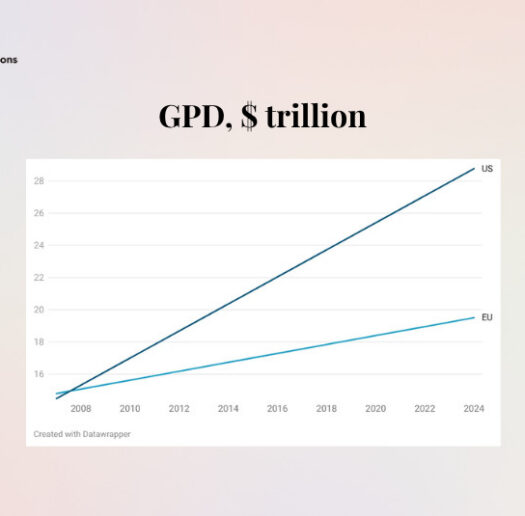
Source: World Bank, taken from Paul Krugman's Substack
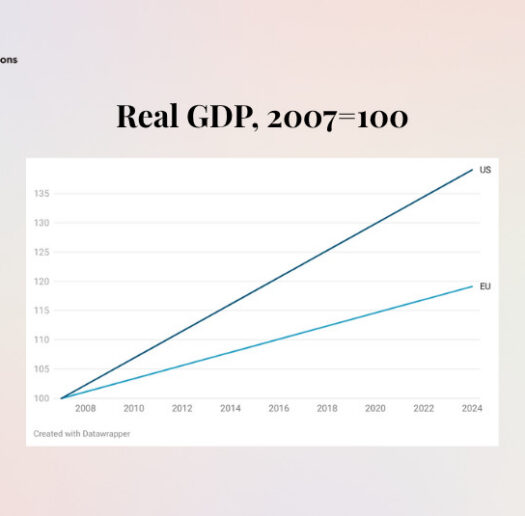
Source: World Bank, taken from Paul Krugman's Substack
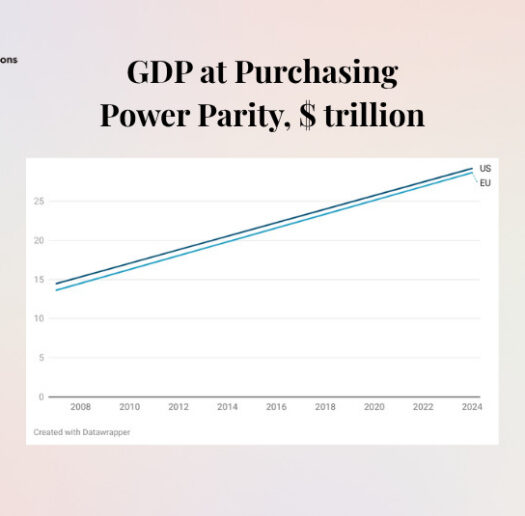
Source: World Bank, taken from Paul Krugman's Substack
Some of the apparently damning economic data at the heart of the Draghi and Letta reports looks rather different depending on how you measure it. Adjusting for currency and purchasing power parity closes much of the headline gap between European and American GDP. As the economist Ronald Coase observed, if you torture the data, it will confess. Three different ways of reading the EU-US productivity gap produce three very different conclusions — none of them obviously the right one. This is not to say, of course, that the EU has gotten everything right – it most certainly hasn’t, otherwise CFG wouldn’t exist – but it’s very hard to find long-term solutions when you start with a misdiagnosis.
The American innovation model has produced digital platforms that reshaped how people work, communicate, and trade – these are genuine achievements. But looking only at headline growth figures does not capture a population increasingly furious about their economic prospects.
According to the Washington Center for Equitable Growth’s Inequality Tracker, income growth since 2000 has been highest for households in the bottom 50% and the top 10% — while the broad middle has been largely left behind, its wage growth slower than any other income source over the past two decades[3]. Federal Reserve data shows the bottom 50% of American households hold just 2.5% of the nation’s total wealth, a figure that has barely shifted in a generation[4]. Meanwhile the EU’s Gini coefficient – the standard measure for economic inequality – has continued falling, sitting at 29.4 by 2024 versus 41.8 in the United States[5].
Comparing the innovation outcomes of incredibly different models of prosperity is not a simple thing, because it means comparing fundamentally different assumptions about who economic growth is for.
The 2024 Nobel Prize in Economics recognised Acemoglu, Johnson, and Robinson for establishing an empirical basis for exactly this critique. Their research shows that inclusive institutions generate sustainable prosperity while extractive ones produce short-term gains for those in power, then stall[6]. World Bank data on GDP per capita shows that the richest countries are more than 50 times wealthier than the poorest[7] — and their Nobel-cited research identifies this gap as driven predominantly by institutional differences, not geography, culture, or natural resources. That is a far more solid foundation for intergenerational fairness than GDP growth rates: if what determines long-run prosperity is whether the rules distribute power and opportunity broadly, then the question for future generations is not whether Europe is winning a technology race today, but whether the governance systems being built now are ones they can still use, challenge, and benefit from.
Overfitting on overregulation
Behind the competitiveness narrative sits a corollary that now shapes what counts as serious policy discussion in Brussels: that European regulation is strangling innovation. The research does not support this.
In a peer-reviewed analysis of the relationship between digital regulation and technological progress, Columbia Law School’s Anu Bradford demonstrates that the US-EU technology gap cannot be primarily attributed to tech regulation — and that the four real structural drivers are a fragmented digital market where scale is harder to reach, underdeveloped capital markets, bankruptcy laws among the most punitive in the world, and insufficient pathways to attract global talent[8]. The European Investment Bank’s own data bears this out: VC investment in American companies runs six to eight times higher than in the EU every year, and EU funds raise just 5% of global venture capital against 52% in the United States — a gap that widens as companies mature rather than at the early stages where regulatory burden would bite hardest[9].
There is also a case to be made that well-designed regulation promotes competition rather than constraining it. This is the entire premise of antitrust law, which has existed in some form since the late nineteenth century precisely because unregulated markets tend toward concentration. The economics literature is consistent on this point: competitive pressure is one of the most reliable drivers of innovation, while market dominance tends to suppress it[10]. The much maligned EU’s Digital Markets Act is a direct application of this logic to technology — an attempt to restore contestability to markets where network effects and platform control had made genuine competition structurally difficult. Framing that as anti-innovation regulation misunderstands what the regulation is trying to do.
A simple look at the timeline of digital innovation illustrates the point. Google, Apple, Microsoft, Meta, and OpenAI were all founded 20 to 30 years before the GDPR, DMA, DSA, or AI Act existed. Regulation responds to innovation — it cannot explain a gap that predates it.
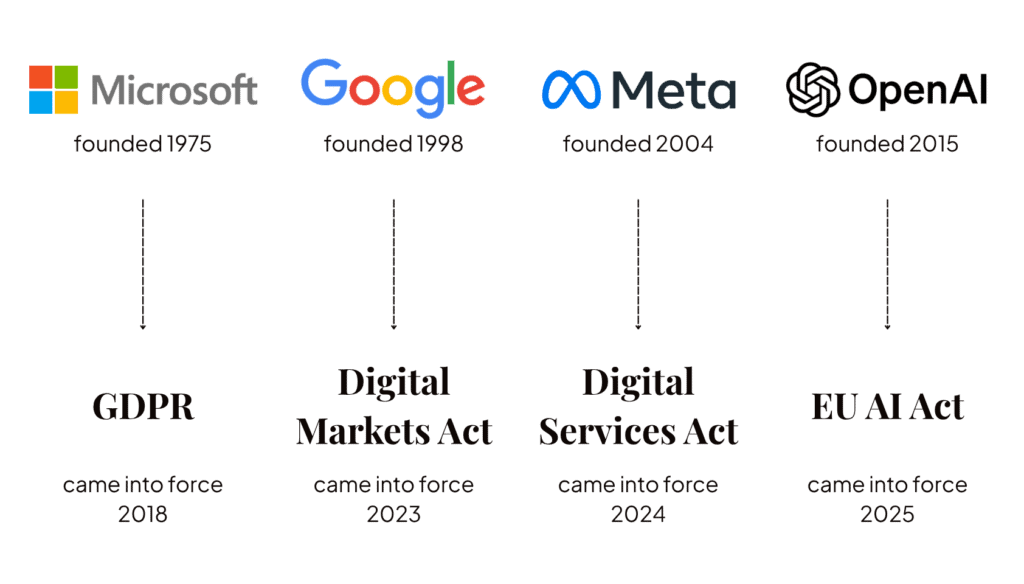
Accepting the overregulation narrative means letting the real problems go unaddressed. Even worse, the rush to cut red tape discards protections that current and future generations will benefit from – without actually solving anything. Europeans lose the baby but keep the dirty bathwater.
None of this is to say Europe’s regulatory framework is without fault. The AI Act’s implementation has been interrupted from the very start — practical compliance guidance arrived months late, leaving startups unable to plan hiring and technical roadmaps in advance, and prompting an open letter from over thirty founders and investors warning of a “fragmented, unpredictable regulatory environment”[11] The GDPR has generated compliance burdens that fall disproportionately on smaller firms: Centre for Economic Policy Research research found no significant profit impact on large tech companies following its introduction, but double the negative effect for small IT companies — an outcome that may have strengthened the very incumbents the regulation was designed to constrain[12].
There are genuine questions about whether some rules were designed with sufficient attention to their practical effects. But we can acknowledge flaws without indicting the entire enterprise of technology governance, and in doing so, avoiding the harder conversation about capital markets, market fragmentation, and talent.
This matters because the laws Europe has developed for emerging technologies, for all their imperfections, were reached through a deliberative democratic process. As we have argued in our submission to the European Commission’s Intergenerational Fairness Strategy, the concentration of technological and economic power in a handful of private actors has already weakened citizens’ ability to shape decisions that govern their lives. Reversing that requires rebuilding democratic capacity: civic participation, transparent decision-making, and equitable access to digital tools. These are the conditions that allow citizens to act freely and collectively in shaping their future — and dismantling the regulatory architecture in the name of competitiveness does precisely the opposite.
What Europe’s existing legislation requires is not abolition but enforcement. The AI Act is a glaring example: passed recently and essentially never tested, it is already on trial in the court of Brussels opinion. This is what we at CFG call “the enforcement gap“, and it is itself an intergenerational fairness problem. If the rules written today are not implemented, the people who inherit those systems inherit cumbersome rulesets that need revision — but without any of the protection they were supposed to provide.
The governance we haven’t done yet
The third problem is less explicit than the other two, but perhaps the most consequential. It is the assumption embedded in how European institutions actually operate: that governance responds to crises rather than anticipating them.
Consider neurotechnology. Devices that interface with the nervous system are already available to buy online — wellness products, sleep trackers, gaming headsets, productivity tools being integrated into the headphones and glasses people already wear. Brain data is qualitatively different from other personal data. Its governance is not a niche technical concern. It is a question about what kind of cognitive autonomy future generations will have. Europe currently has the second-largest neurotechnology sector in the world, representing a genuine opportunity to lead — but only by getting there before the market does, not by drafting a framework a decade after deployment, once harms have compounded and dependencies are locked in.
The same logic applies to AI. The IMF has described the current technological transition as potentially comparable in scale to the Industrial Revolution[13]. The societies that shaped that transition and those that did not were distinguished not by who had the raw materials or the factories, but by who wrote the rules — and whether those rules served broad prosperity or concentrated gains. The AI governance questions that matter for future generations are not which company will dominate the emerging market. They are whether AI generates wealth or harm, whether economic value flows within or beyond Europe, and whether the benefits are distributed fairly. These questions are largely absent from the current conversation.
When you are always catching up to what just happened, anticipatory governance becomes structurally impossible. The Brussels pessimism that runs through all three narratives — we are always behind, always reacting — is much larger than a simple communication problem. It has direct consequences for the quality of governance that future generations will inherit.
What closing the gap actually requires
None of this is inevitable. The European Commission’s decision to create a Commissioner for Intergenerational Fairness is a meaningful institutional signal, and the forthcoming Intergenerational Fairness Strategy is a genuine opportunity to act on it. CFG’s submission to that process sets out our detailed proposals, centred on three parallel commitments.
- Inclusion: embedding future generations into policymaking through mandatory intergenerational impact assessments for technology, climate, and economic strategy — weighing both the risks of action and the opportunity costs of inaction on both sides of the ledger.
- Capacity: treating anticipatory governance as a core competency rather than a peripheral function. Not foresight units operating at the margins of policy, but futures literacy built into how policymakers across institutions actually work.
- Strategy: making deliberate choices about which technologies to accelerate and which to approach with restraint, based on European realities rather than reflexive comparison with the United States or China.
Having recently returned from paternity leave, I am perhaps not the most objective person to be making this argument. But the experience of spending four weeks thinking almost exclusively about a person who will live most of their life in a world we are currently building does sharpen the mind. My daughter won’t remember any of the decisions being made in Brussels right now. She probably won’t even know they happened. That is, if you think about it, exactly the problem this piece has been describing.
Future generations are not an abstract governance concept. They are the constituency with the least representation and the most at stake.
[1] Dave Keating, The Owned Continent: How to free Europe from American military, economic and cultural dependence (Brussels: self-published, December 2025), https://theownedcontinent.eu/
[2] The Good Lobby, ‘Shaping the EU Strategy on Intergenerational Fairness’, The Good Lobby, 16 September 2025, https://thegoodlobby.eu/shaping-the-eu-strategy-on-intergenerational-fairness/ (accessed March 2026). See also European Commission, ‘Citizens’ Panel on Intergenerational Fairness’, https://citizens.ec.europa.eu/citizens-panel-intergenerational-fairness_en (accessed March 2026).
[3] Washington Center for Equitable Growth, ‘Slow wage growth is the key to understanding US inequality in the 21st century’, Equitable Growth, July 2025, https://equitablegrowth.org/slow-wage-growth-is-the-key-to-understanding-u-s-inequality-in-the-21st-century/ (accessed March 2026). ↩
[4] Federal Reserve Board, ‘Distribution of Household Wealth in the US since 1989’, Distributional Financial Accounts, Q4 2024, https://www.federalreserve.gov/releases/z1/dataviz/dfa/distribute/chart/ (accessed March 2026).
[5] Eurostat, ‘Gini coefficient of equivalised disposable income’, https://ec.europa.eu/eurostat/databrowser/view/ILC_DI12 (accessed March 2026); OECD, ‘Income Distribution Database’, https://www.oecd.org/en/data/datasets/oecd-income-distribution-database.html (accessed March 2026)
[6] Acemoglu, Johnson, and Robinson use “institutions” in a specific sense: the formal and informal rules that structure economic and political life — property rights, rule of law, the distribution of political power, and the mechanisms by which contracts are enforced. Inclusive institutions are those designed to allow broad participation and constrain elite capture; extractive institutions concentrate power and opportunity in a small group. See Daron Acemoglu and James A. Robinson, Why Nations Fail: The Origins of Power, Prosperity, and Poverty (New York: Crown, 2012). For the Nobel citation, see Royal Swedish Academy of Sciences, ‘The Prize in Economic Sciences 2024’, October 2024, https://www.nobelprize.org/prizes/economic-sciences/2024/press-release/ (accessed March 2026).
[7] Our World in Data, ‘GDP per capita’, drawing on World Bank sources, https://ourworldindata.org/grapher/gdp-per-capita-worldbank (accessed March 2026).
[8] Anu Bradford, ‘The False Choice Between Digital Regulation and Innovation’, Northwestern University Law Review, Vol. 119, No. 2 (2024), https://scholarlycommons.law.northwestern.edu/nulr/vol119/iss2/3/ (accessed March 2026). Bradford presented the core argument at CFG’s Think & Do 2025 conference; a write-up is available at https://cfg.eu/challenging-europes-assumptions-think-do-2025/
[9] European Investment Bank, ‘The Scale-Up Gap: Financial Market Constraints Holding Back Innovative Firms in the European Union’, EIB, July 2024, https://www.eib.org/en/publications/online/all/the-scale-up-gap (accessed March 2026).
[10] Carl Shapiro and Howard Shelanski, ‘Antitrust and Innovation: Welcoming and Protecting Disruption’, Innovation Policy and the Economy, Vol. 20 (2020), https://www.journals.uchicago.edu/doi/full/10.1086/705642 (accessed March 2026). For the broader relationship between competition and innovation, see also Anu Bradford, ‘The False Choice Between Digital Regulation and Innovation’, Northwestern University Law Review, Vol. 119, No. 2 (2024).
[11] Zach Meyers, ‘Better Regulation and the EU’s Artificial Intelligence Act’, Intereconomics, Vol. 60, No. 3 (2025), pp. 149–153, https://www.intereconomics.eu/contents/year/2025/number/3/article/better-regulation-and-the-eu-s-artificial-intelligence-act.html (accessed March 2026). On the open letter, see Vestbee, ‘EU AI Act takes effect, and startups push back’, September 2025, https://www.vestbee.com/insights/articles/eu-ai-act-takes-effect-what-you-need-to-know (accessed March 2026).
[12] Santesteban Corcín et al., ‘The GDPR Effect: How Data Privacy Regulation Shaped Firm Performance Globally’, VoxEU/CEPR, https://cepr.org/voxeu/columns/gdpr-effect-how-data-privacy-regulation-shaped-firm-performance-globally (accessed March 2026). See also Frey et al., ‘Privacy regulation and firm performance: Estimating the GDPR effect globally’, Economic Inquiry, 2024, https://onlinelibrary.wiley.com/doi/10.1111/ecin.13213 (accessed March 2026).
[13] Gita Gopinath, ‘Harnessing AI for Global Good’, Finance & Development, IMF, December 2023, https://www.imf.org/en/Publications/fandd/issues/2023/12/ST-harnessing-AI-for-global-good-Gita-Gopinath (accessed March 2026).