


Policymakers’ questions explored: “Does international law prevent SAI deployment?”
Existing international rules were not designed with stratospheric aerosol injection in mind — if some international law principles and existing treaty regimes offer partial constraints, none amount to an effective barrier against unilateral deployment.
Three weaknesses stand out:
- The concept of territorial sovereignty is insufficient to prevent deployment:
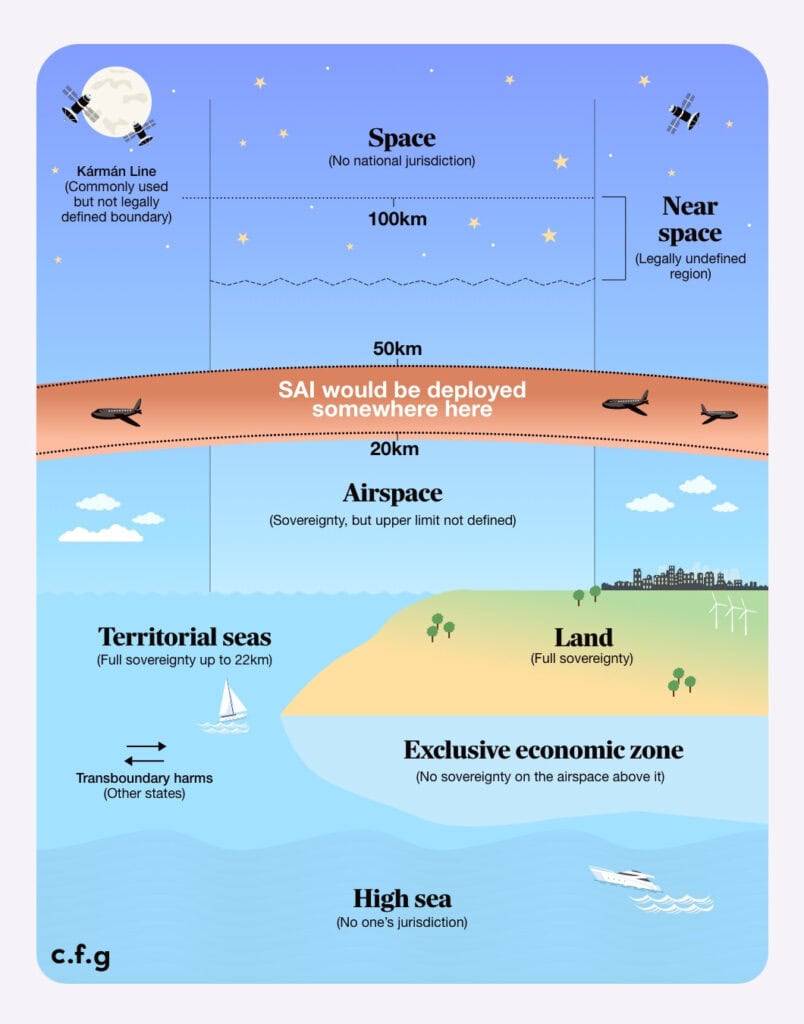
- States may forbid flights in their sovereign airspace, including territorial seas. However, airspace sovereignty does not extend to their exclusive economic zone and the high seas, more than half of the Earth’s surface.
- Since international law does not define where airspace ends, and outer space begins, sovereignty does not clearly extend to the stratosphere, where deployment would take place (at altitudes of 20-50km). [1]
- Even if there were no violation of sovereign airspace, cooling aerosols would still spread globally.
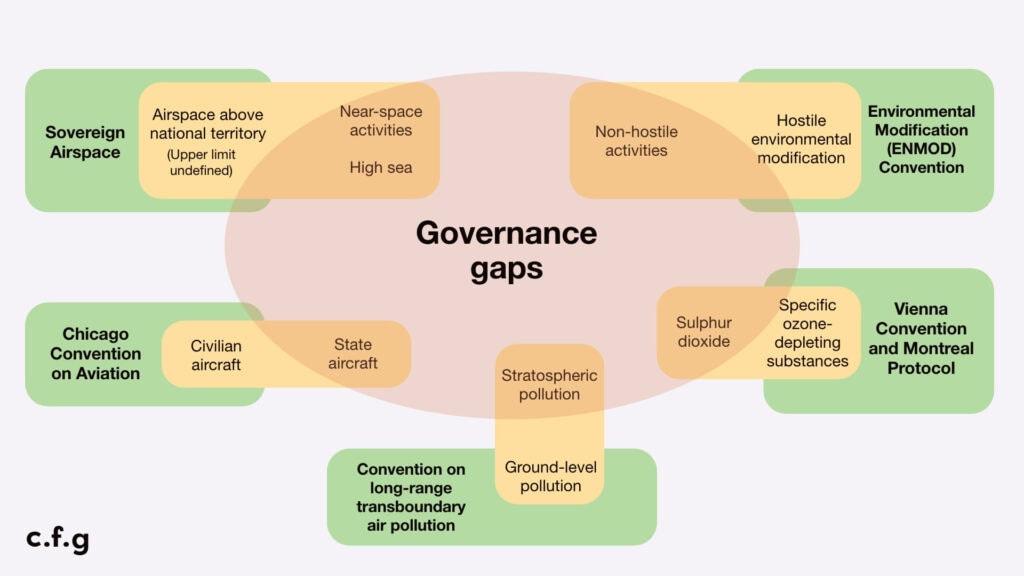
- Existing treaties regulate certain pollutants, but none cover the deliberate and non-hostile release of aerosols in the stratosphere.
- The duty to prevent environmental transboundary harm, rooted in international law, also falls short: it is mainly a procedural obligation[2]. It is challenging to enforce, given the diǖculties of proving harm or a risk of harm.
Could a country or private actor deploy Stratospheric Aerosol Injection on its own?
A single individual is highly unlikely to launch a sustained deployment of Stratospheric Aerosol Injection at scale on their own. SAI deployment, which is global almost by definition, requires significant infrastructure, including multiple airbases, a sizable fleet of dedicated aircraft, and at least tacit government approval. However, a state – or group of states – with sufficient technical capacity and resources could, in theory, attempt deployment. For a meaningful impact on the global climate, however, deployment would need to be spread at least across both hemispheres.
Single-hemisphere deployment may be feasible, but it would come with catastrophic effects. For example, altering the regional movement of the monsoon that sustains the livelihoods of hundreds of millions, drying some regions while flooding others, could destabilise already fragile areas: fueling cross-border tensions, sparking humanitarian crises, or even armed conflicts.
Is SAI deployment technically feasible in a few years?
Small-scale deployment at lower altitudes in the polar regions could be feasible within a few years, as it could rely on existing aircraft designs, but it would have a limited impact on global temperatures. While the limited cooling might make such tests seem irrelevant, they could reveal technical capabilities and limitations, and potentially be geopolitically disruptive.
Limited-scale testing of SAI could therefore be feasible in the near future; however, large-scale, climate-altering aerosol injections at high altitudes (20–25 km) would not yet be possible. The fleet of aircraft and infrastructure required to deliver large quantities of aerosols at altitudes of 20–25 km has not yet been built. Large-scale deployment would involve scaling a significant industrial operation for the development and fleet production of dedicated aircraft types capable of operating eǖciently at high altitude.[3]
Even with strong political will, developing such a fleet for continuous large-scale deployment would take 10 to 20 years. Estimated operational costs – 10-20 billion € per year – place such a program in the realm of only major economies.[4]
Can countries legally deploy SAI on their own territory?
States have exclusive authority over their territory, including land, waters, and airspace,[5] so SAI could theoretically be deployed domestically. However, states must prevent activities under their jurisdiction from causing significant transboundary harm[6], which imposes precautionary and procedural obligations (e.g., impact assessments, consultation with affected states, mitigation measures).
While these obligations do not prohibit unilateral deployment or the development and testing of the technology, failure to comply could trigger state responsibility, potentially leading to claims for cessation, assurances of non-repetition, or reparations. However, proving the significance and attribution of harm (or risk of significant harm) – and even determining whether these activities occur on another state’s territory- would be extremely challenging, especially in the absence of an international monitoring system. Nevertheless, such claims could be geopolitically destabilising: state disputes have escalated over far smaller and less certain cross-border harms.
What about deployment over another state’s territory?
State or military aircraft – which would likely be used for SAI – cannot fly over another state’s sovereign territory without their authorisation. However, territorial airspace sovereignty has limits:
- Sovereignty only extends to a country’s land and territorial seas, which are limited to 12 nautical miles from the coast, and the airspace above them.[7] This leaves the high seas and exclusive economic zones[8] – together making up more than half the Earth’s surface – outside of any state’s jurisdiction.
- Because particles would disperse globally and over areas such as the high seas, it is far beyond the control of any single country; thus, national sovereignty over airspace cannot, by itself, regulate or prevent SAI.
- Additionally, SAI would occur in the stratosphere (at altitudes of around 20–50 km), and it could be debated whether a country’s airspace includes activities at such altitudes, as international law does not define where airspace ends and outer space begins. The Kármán line (100 km altitude) is occasionally used for such delineation, but no treaty or customary law affirms this.[9]
What legal responses exist if SAI is sprayed over another state’s territory without its consent?
States may intercept or escort out of their airspace unauthorised foreign state or military aircraft intruding into their sovereign airspace, but the use of force is lawful only as a last resort and in proportion to the threat.[10] In practice, SAI deployment over another state’s territory by an aircraft in the stratosphere would likely constitute a breach of sovereignty and could trigger diplomatic, legal, or economic countermeasures. It would only amount to an “armed attack” – justifying military self-defence [11]– if it caused severe, widespread, long-lasting and intentional harm.
Are other existing treaties or norms relevant to prevent deployment outside state jurisdictions?
Yes, several existing treaties are relevant, but they leave a significant governance gap:
- The Convention on Long-Range Transboundary Air Pollution (CLRTAP) regulates ground-level pollution, including sulphur dioxide, but it does not cover the stratosphere. It could become relevant if SAI particles eventually descend and harm air quality, ecosystems, or agriculture. However, the Treaty is not applied globally, whereas SAI is expected to have effects across borders (although not evenly distributed).[12]
- The Vienna Convention for the Protection of the Ozone Layer and its Montreal Protocol aim to protect the ozone layer and could, in theory, be adapted to cover substances used for SAI. Both treaties have achieved universal ratification, and the Montreal Protocol has a strong record of flexibility in responding to new scientific findings by adding chemicals to its list of controlled substances. Although sulphur dioxide — the main substance considered for SAI — is not currently listed as a controlled chemical, in principle, it could be added through an amendment.
- The Environmental Modification Convention (ENMOD) prohibits only the hostile modification of the environment that has widespread, long-lasting, or severe effects.[13] ENMOD could apply to SAI if it were used with hostile intent and met the cumulative criteria, but it does not govern peaceful research or deployment. Additionally, SAI would be a very inapt weapon, as its effects are expected to be diffuse, slow, and uncertain, which means it wouldn’t be possible to have a precise target or predictable impacts.
- The Convention on Biological Diversity – to which the United States is not a party[14]– has issued decisions on SRM urging Parties to research its risks and refrain from deploying SRM that aǕects biodiversity without adequate scientific basis, governance, and risk assessment. However, these decisions are not legally binding.
- The Chicago Convention on International Civil Aviation, which has 193 state parties, including all member states of the UN, does not apply to state aircraft operations, which are expected to be used in SAI deployment or testing.
Would an approach based on international norms be effective in a world of tense geopolitics?
While the identified gaps in current international law could be filled, the history of governing spaces outside of unambiguous sovereignty reveals the limitations of governing through international norms. Space law, the Antarctic Treaty System, and international maritime law exemplify that eǕective governance necessitates a careful balance of hands-on cooperation and the development of standards, recognizing that rigid norms are rarely successful.
A regulatory regime is unlikely to succeed in preventing unilateral action on SAI unless it reflects the enlightened self-interest of major powers, recognising mutual adherence to be in their own interest.
So, what could European governments do?
- Explore the creation of a multilateral or international monitoring and detection system for Solar Radiation Modification (SRM) as a first step toward a more integrated governance framework through a dialogue among EU Member States, including:
- Their space agencies and the European Space Agency (ESA) with satellite monitoring capabilities;
- Their meteorological agencies and European Organisation for the Exploitation of Meteorological Satellites (EUMETSAT) with the scientific expertise needed for attribution;
- EU institutions and key international actors in the Global North and South.
- Share information with other governments to build a coalition of States committed to mutual learning on the issue and developing common positions for normative approaches at the regional and international level.
- Create opportunities for structured intergovernmental conversations to identify governance needs and options for preventing uncoordinated deployment, while also refining the rules for research, including, if appropriate, controlled small-scale scientific experiments.
[1] While most SAI research examines deployment at 20km altitude, some have considered deployment in the upper parts of the stratosphere including at 50km above ground.
[2] A procedural obligation requires states to demonstrate efforts, but it does not oblige them to achieve a defined outcome.
[3] Smith, W., An assessment of the infrastructural and temporal barriers constraining a near-term implementation of a global stratospheric aerosol injection program. Environ. Res. Commun., 2024.
[4] To learn more, see European Commission, Solar radiation modification: Evidence review report, 2024 – See Part 1: Technological research, development and potential deployment, Chapter 2: Proposed solar radiation modification interventions and W. Smith, An assessment of the infrastructural and temporal barriers constraining a near-term implementation of a global stratospheric aerosol injection program, 2024
[5] See Island of Palmas Arbitration (1928); Montevideo Convention , Art. 1; UNCLOS, Art. 2(1); Chicago Convention, Art. 1.
[6] This duty was first recognized in the Trail Smelter arbitration (1941) and reaffirmed by the International Court of Justice in later cases.
[7] Art. 2 UNCLOS; Art. 1 Chicago Convention
[8] Under the United Nations Convention on the Law of the Sea (UNCLOS), the “Exclusive Economic Zone”(EEZ) is the area beyond a state’s territorial sea (up to 200 nautical miles), within which that state holds sovereign rights for the exploration, exploitation, conservation, and management of natural resources. The “high seas” comprise all parts of the ocean not included in any state’s EEZ, territorial sea, or internal waters.
[9] The International Association for the Advancement of Space Safety (IAASS) has proposed defining “near space” (18–160 km above sea level), attributing jurisdiction to states over near space above their territory and maritime zones, while assigning to the International Civil Aviation Organization (ICAO) authority over near space above the high seas. This is, however, only a proposal.
[10] See the ICJ case U.K. v. Albania (1949) and the International Civil Aviation Organization’s recommendations.
[11] The exception to the prohibition of the use of force set in the article 51 of the UN Charter.
[12] There are only 51 States parties to the Convention. China, for example, is not a Party.
[13] Only 78 states have ratified or acceded to the treaty, countries such as France and Mexico have not.
[14] The Convention has been ratified by 196 States (all UN member states) with the exception of the United States.