

Towards governance of climate cooling approaches
This paper is part of CFG’s SAFEGEOGOV project, which equips European policymakers to explore plausible future scenarios and design governance options for high-stakes decisions on solar radiation modification (SRM). It was supported by funding from the Advanced Research and Invention Agency (ARIA) through the Exploring Climate Cooling programme.
Executive summary
Stratospheric aerosol injection (SAI) is a form of solar radiation modification (SRM) that would reflect a portion of sunlight back into space to reduce global temperatures. It is not a solution to climate change. It would not reduce atmospheric carbon concentrations, or reverse ocean acidification, but it could lower global temperatures within months while mitigation and carbon removal take effect over decades. Its consequences would be global, imperfect, and unevenly distributed. Decisions about SAI research, deployment, and governance are contested.
Existing analysis of SAI has been scientifically sophisticated but politically simplistic. Real-world decisions will be taken under social, economic, and geopolitical conditions that formal climate models do not represent. This report changes that: it offers four 2036 scenarios outlining the plausible conditions under which SAI decisions may need to be taken, along with a facilitation tool that policymakers can use to test how governance arrangements might hold up, or fail, under each.
Scenario development
The scenarios were developed through a dual-track foresight process involving over 250 policymakers, scientists, civil society representatives and citizens across multiple regions globally, alongside a structured assessment by twenty-two experts. They assume a 2036 reached on an emissions trajectory not far off the current one, leaving SAI a live policy question rather than a technology choice overtaken by rapid decarbonisation.
Six observations across the four scenarios
Read together, the scenarios generate observations that hold across all four:
- Politics, not climate science, may drive SAI decisions. Values coalitions, cost-of-living politics, self-defence or rivalry shape outcomes more than scientific ideal-cases.
- Owning research capacity is itself a governance choice. States that lack technical expertise may be negotiating from a weaker position, whether their intent is to deter or enable deployment.
- Public deliberation capacities are key. Trust is earned slowly and lost quickly. Early engagement and transparency support a factual information ecosystem; late engagement leaves the field for others.
- Independent monitoring and attribution is position-neutral infrastructure. The capacity to know who is doing what in the atmosphere is useful regardless of what position countries take on SAI itself.
- The climate and security policy communities are having different conversations about SAI, and neither is hearing the other. If those who hold moral hazard, equity, and intergenerational concerns do not engage in defence and commercial spaces, the framings that will prevail will be brought by the actors that are in the room.
- Defensible SAI deployment presupposes accelerated mitigation and a credible off-ramp. The expert analysis found that defensible SAI deployment scenarios were consistently paired with accelerated mitigation efforts; deployment without such acceleration was not judged to be plausible.
How to use the report
The scenarios are the first half of a tool designed for structured policy planning. The second half is a facilitation guide offering three techniques for using the scenarios in workshop settings: the futures wheel (exploratory), robustness testing (evaluative), and backcasting (temporal). Each supports different workshop purposes, and together they help policymakers test how governance arrangements might hold up, or fail, under a range of plausible scenarios.
Introduction
Stratospheric aerosol injection (SAI) is a contested proposal that has been researched as a climate intervention to counter anthropogenic warming. It involves injecting stratospheric aerosols to reflect a portion of sunlight back into space, cooling the planet.[1] Research, technology development, and use are different acts, and this report treats them as such. SAI is not a solution to climate change. It does not directly reduce atmospheric carbon concentrations, nor reverse ocean acidification. What it could do is reduce global warming while mitigation and carbon dioxide removal efforts take effect. The consequences of SAI cannot be localised, so decisions about SAI governance, research or deployment are global in effect and thus inherently controversial.
This work presents diverse, plausible 2036 scenarios to aid policymakers’ preparedness for possible future decisions on SAI. The scenarios were co-created with policymakers to support anticipatory planning of robust, ethical, and proactive responses to various future SAI research and deployment challenges. The scenarios are diverse and plausible to aid consideration of a broad range of possible futures. Each outlines a situation in which a policymaker is required to consider SAI’s efficacy, legitimacy, and desirability, and its economic and geopolitical implications.
The scenarios were co-created with a dual-track methodological foresight approach involving over 250 policymakers, scientists, civil society representatives and interested citizens. Morphological scenario generation was carried out iteratively by drawing upon over 100 interviews with people from diverse fields and expertise, and from workshops attended by a further 130 participants. In a simultaneous, separate methodological track 22 experts from diverse fields progressed through a structured, software-supported approach to identify key influence factors, analyse their interdependencies and create mathematically plausible models of the future. Full details of the methodological approaches are provided elsewhere.[2]
These scenarios are diverse and plausible 2036 snapshots. They can help policymakers stress-test the social and geopolitical implications of SAI through proactive planning.
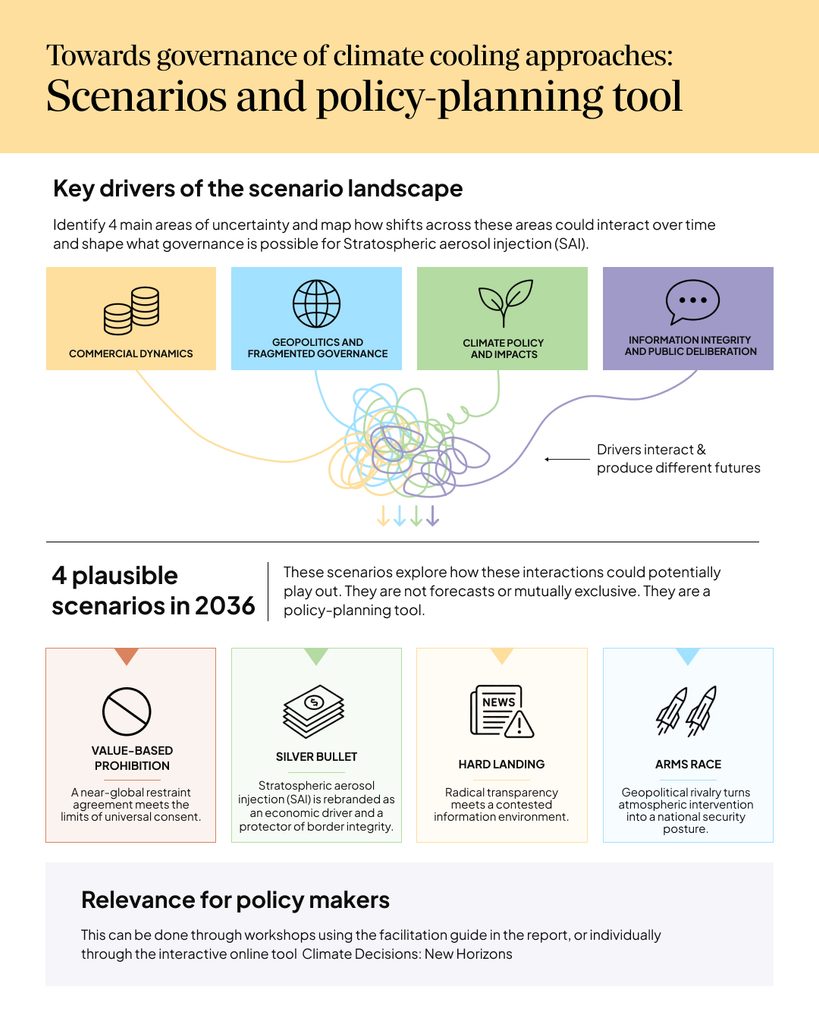
The scenarios are:
- A values-based prohibition: A global agreement on solar geoengineering meets the limits of universal consent.
- Silver bullet: SAI rebranded as an economic driver and a protector of border integrity.
- Hard landing: Radical transparency meets a contested information environment.
- Arms race: Geopolitical rivalry turns atmospheric intervention into a national security posture.
Report context and scope
SAI may currently be transitioning from a fringe idea to a focal point of global climate and security policy. SAI is one of several proposed approaches to solar radiation modification (SRM), the broader category that also includes marine cloud brightening, cirrus cloud thinning, space-based reflectors, and surface albedo enhancement. Of these, SAI is the most studied and the most widely considered plausible at scale, and it is the focus of this report. For nearly three decades SAI has occupied a contested and marginal space in climate policy. This may be changing, driven by accelerating climate impacts, the erosion of confidence in some communities in mitigation policy and the entry of commercial and security actors into a field previously dominated by scientists.
The following analysis, and the scenarios it inspires, rest on a single underlying assumption about the climate trajectory. Each of the four scenarios in this report imagines a 2036 in which the emissions curve is either still rising or falling marginally, leaving SAI as a policy-relevant issue for controlling future warming and addressing historical warming. That assumption is consistent with current trajectories but it is not the only possibility. If the political economy or technological trajectory of climate action were to shift in a meaningful way, SAI could fade from policy relevance entirely. This report was designed to explore scenarios in which policymakers may need to make decisions about SAI, so futures in which such decisions never become necessary are not considered here. The four scenarios that follow imagine futures in 2036 in which unforeseen technological or policy leaps to rapidly address climate change have not come to pass.
The landscape shaping SAI governance
This section maps the forces shaping SAI governance discussions; it is not directionally predictive. The four scenarios reflect plausible ways those forces – constraining and enabling, convergent and contradictory – could interact. None is inevitable, but each is designed to be instructive for policy planning.
Four areas of uncertainty that may influence SAI development are examined: the commercial dynamics of SAI, the governance and geopolitical landscape, the climate policy context, and the information environment shaping public understanding and political legitimacy. Each subsection sets out current dynamics, the directions they might take, and the uncertainties that may shape which direction prevails.
Commercial and private sector interest
Private actors are entering the SRM market faster than governance frameworks can adjust, and SAI is where most of the capital is concentrated. Commercial investment in SRM has grown rapidly from effectively zero in 2023[3] to over US$115 million committed across nine startups in 2025.[4] The largest capital investment has been to the US-Israeli SAI startup Stardust, attracting $75 million in venture capital since establishment in 2023. Despite being many orders of magnitude less than investment in technologies such as AI, the technological readiness of SAI is much lower and so comparatively modest investments may significantly accelerate development.
Two distinct commercial models are emerging, reflecting different assumptions about how SAI could be financed and under what conditions. Stardust assumes a government contractor model of commercialisation. It is developing proprietary technologies (with associated intellectual property), lobbying Washington to shape a regulatory environment relevant to its operations, and aiming to be deployment-ready by 2030 at a proposed cost of more than a billion dollars a year to government clients. The company states it will not act without government authorisation, so its investors are explicitly betting that governments will eventually need the technology as temperatures rise and political action to cut emissions remains ineffective. In contrast, the retail model of US startup Make Sunsets has attracted over $1 million in venture capital. The firm releases sulphur dioxide balloons, direct-selling cooling credits to retail buyers outside any recognised regulatory framework.[5] While Make Sunsets relies on direct radiative effects from SAI, an alternative commercialisation model involves deploying SAI for its carbon cycle impacts,[6] and selling carbon credits on established carbon trading markets. Presently, there is no standards ecosystem for such credits.[7]
Accelerating commercial interest in SAI is moving the governance challenge beyond the environmental fora that have typically considered it. SAI companies (if selling to government clients) commercialise the prediction that the physical impacts of climate change (see Box 1) will intensify to a point where demand for atmospheric cooling becomes politically unavoidable. Their emerging infrastructure sits in a regulatory space that environmental governance was not designed to reach. If SAI begins to be seen as a prestige technology or a tool of geopolitical leverage, then considering SAI as a climate intervention no longer captures the full governance challenge.
Box 1. The consequences of continued global warming are severe
The governance and geopolitical landscape
A patchwork of legal regimes is relevant to SAI, but none were designed for deliberate planetary-scale climate intervention. Customary laws relevant to SAI include the obligation of states to prevent local activities from causing significant transboundary harm.[33] Relevant treaties include the Convention on Biological Diversity,[34]London Convention[35] and its Protocol (LC/LP),[36] the Convention on the Prohibition of Military or Any Other Hostile Use of Environmental Modification Techniques (ENMOD),[37] the Convention on Long-Range Transboundary Air Pollution,[38] the UN Convention on the Law of the Sea (UNCLOS),[39] the Vienna Convention for the Protection of the Ozone Layer,[40] and the Montreal Protocol.[41] Because SAI was not taken into consideration when these regimes were designed, they produce uneven applicability. Further, there is scope for selective interpretation, regulatory arbitrage, and the deliberate positioning of activities to fall within or outside specific regimes.[42]
The Convention on Biological Diversity and London Protocol are the most relevant instruments to SAI. The Convention on Biological Diversity’s non-binding Decision X/33 recommends a precautionary approach to geoengineering activities that may affect biodiversity, permitting small-scale scientific research conducted in controlled settings, and encouraging transdisciplinary research to address key uncertainties. Subsequent CBD decisions have sustained a political expectation of restraint without offering a treaty-level prohibition. The US is not a party to. Similarly, an amendment to the London Protocol covering marine geoengineering signals regulatory intent but has not entered into force given the lack of sufficient ratifications by the parties.
The primary gap in SAI research governance is not a lack of principles but their operationalisation and international coordination. Major scientific and policy reviews – by the Royal Society, the US National Academies, UNEP, and the European Commission’s Scientific Advice Mechanism – converge on the features of responsible SAI governance: transparent disclosure and registries, independent impact assessment, monitoring and reporting, meaningful public and stakeholder participation, international information sharing, and adaptive periodic review as knowledge evolves. The Oxford Principles, Asilomar recommendations, a Code of Conduct for Responsible Geoengineering Research, and the American Geophysical Union’s Ethical Framework point in similar directions. What is missing is translation into domestic regulatory systems and the mechanisms of internal coordination.[43]
The distinctions between research and deployment set out in Box 2 are widely recognised as essential to governance, but remain under-specified in practice. There is no shared international taxonomy that formally distinguishes research activity from deployment-adjacent activity, or scientific research from technology development, and no international body currently has authority to enforce such distinctions. Research suggests that establishing this distinction in practice will be contested,[44] creating a grey zone that complicates oversight and amplifies controversy. This matters more as commercial and security-linked actors enter the field; pre-deployment signalling and notification norms apply even more loosely to private actors than to states.
Box 2. Distinguishing SAI activity types
Discussions of SAI governance benefit from distinguishing three broad activity types. These distinctions are not formally recognised in international law, and their boundaries are contested in practice, but they are analytically useful for policymakers considering what different kinds of activity require by way of governance.
- Research activity. Research activities are designed for producing knowledge: reducing uncertainties and studying risks of SAI; they can involve laboratory work, atmospheric modelling, social, ethical, and legal scholarship, and small, brief outdoor process studies that test instruments or measure atmospheric properties. The primary purpose is to generate evidence about SAI’s risks, uncertainties, and possible consequences. The activity is designed to produce no detectable climate effect.
- Deployment-adjacent activity. Outdoor activity conducted at a size and duration sufficient to produce a detectable radiative or regional climate effect. The purpose is to demonstrate operational feasibility, test deployment readiness, or produce regional or even global cooling. This category sits closest to deployment itself and raises the strongest governance questions, particularly where transboundary effects are possible.
- Technology development. Activity aimed primarily at building hardware, delivery systems, intellectual property, or deployment-ready programmes rather than at generating knowledge about risks or uncertainties. Such activity, even where it does not itself produce climate effects, is oriented toward capability rather than understanding, and sits outside of scientific research. Examples in the current commercial market include much of Stardust’s engineering work and Make Sunsets’ balloon releases.
The scenarios in this report engage with these categories differently. The values-based prohibition and arms race scenarios turn largely on technology development and deployment-adjacent activity by state and commercial actors. The silver bullet scenario shows how commercial technology development can proceed at speed while formal deployment authorisation is still being negotiated. The hard landing scenario turns on how ambiguity between activity types can be exploited in a contested information environment.
For over two decades, the dominant political and academic response to the governance gap has been principled restraint rather than active engagement. In 2022 a group of academics launched a formal call for an international non-use agreement on solar geoengineering; over 600 academics from 67 countries have since signed the accompanying open letter calling for an international non-use agreement and related restrictions on public research funding.[45] Their academic case rests on the argument that SAI risks are poorly understood and that outdoor research creates a slippery slope towards deployment. Further they advance a structural claim that planetary-scale technologies cannot be governed equitably and will inevitably favour powerful states over vulnerable ones.
Political leadership has focused primarily on preventing SAI deployment rather than restricting research. The African Ministerial Conference on the Environment (AMCEN) has called for a global governance mechanism for the non-use of solar radiation management (2023 Decision 19/5), and at its 2025 meeting issued an unequivocal rejection of SAI as a climate solution. The African Group led negotiations at the sixth session of the United Nations Environment Assembly (UNEA-6) in February 2024, with Djibouti playing a prominent coordinating role, and was joined by Colombia, Fiji, Mexico, Pakistan, and Vanuatu. Pacific Island nations, led by Vanuatu, have made parallel calls in UN settings for states to prohibit the development and use of these technologies.
The wider geopolitical conditions under which SAI governance must now develop may no longer be those of consensus-based multilateralism. Several interacting forces may shape what governance is possible.[46] The first is great power competition. The US and China are the powers most capable of unilateral large-scale deployment due to their economic and technological might to enact a programme and geopolitical power to facilitate it.[47],[48] A Chinese geoengineering scholar has been quoted as saying that geoengineering may be used (by other countries) as a tool to ‘maintain their hegemony’,[49] and recent US framing of SAI as a matter of weather sovereignty[50] has sharpened the security dimension, raising the prospect that atmospheric governance is absorbed into strategic rivalry. The second is the Global Majority, and African states in particular, which is now the most organised force advocating restraint. There are emerging indicators of a mismatch between governments and publics in these regions: public surveys show Global South publics are more favourable to SAI research than publics elsewhere,[51] leaving open whether the anti-SAI governance assertiveness continues, or instead shifts in response to public demand for equitable access to SAI policy influence in a free-driver policy environment.[52] The third is the role of middle powers and issue-specific minilateral coalitions, which could prove decisive if they can hold a cooperative centre in the event that consensus-based institutions weaken; middle powers such as India, Brazil, Germany and Canada benefit from their geographical dispersal and relative lack of unified strategic opponents. Cutting across all three, the diffusion of capability to non-state actors may outpace state-led governance altogether if financial support exists from broad-based publics, corporations, or philanthropic donors.
The climate-policy context
Decarbonisation of each joule of energy used is happening but not fast enough to offset energy growth and thus to avoid significant warming. Renewable energy costs have fallen faster than anticipated, the International Energy Agency has revised its renewables forecasts upward multiple times, and global clean energy investment now substantially exceeds investment in fossil fuels. Even so, current emission reduction pledges put the world on a path to up to roughly 3°C of warming above pre-industrial levels by 2100, and this multi-degree warming is expected to persist for centuries.[53],[54] Without SAI, returning temperatures to less than a 1.5°C increase after overshoot would require not only rapid decarbonisation but carbon dioxide removal at a scale many experts consider neither technically nor economically feasible in the near term.[55],[56],[57]
As the physical impacts of climate change intensify the appeal of SAI may lie in its rapid and inexpensive impact. While carbon removal will take decades to materially alter surface temperatures, SAI could cool the planet within months of deployment at scale. For communities facing repeated or existential climate threats, the difference between months and decades may prove politically decisive.
While interest in SAI might grow as climate change intensifies, so might arguments portraying SAI as a distraction from mitigation. SAI can only ever be a complement to decarbonisation. It addresses the symptoms of warming without fixing carbon concentrations. If deployment were ever stopped while greenhouse gas levels remained high, temperatures could rebound rapidly. This phenomenon, called termination shock, would be disastrous for biological systems that are not tolerant of such rapid changes. This means SAI is only coherent as a policy option in a world that is also seriously pursuing emissions reductions.
The information environment
The information environment is not merely a communication challenge, but is a structural background that will shape whether legitimate public deliberation about SAI is possible at all. Perceptions matter enormously in SAI discussions. The technology’s legitimacy, its political feasibility, and the conditions under which it might be governed may all be determined as much by what publics believe, as by what scientists can demonstrate. Any future governance framework will need to establish and maintain legitimacy within a contested information space where scientific findings are actively disputed, public trust in institutions is uneven and fragile, and the actors shaping public understanding have widely divergent interests (see Box 3). Disinformation about SAI could trigger diplomatic tensions or civil unrest, regardless of the accuracy of the underlying claims.
Box 3. Chemtrail conspiracy theories
Chemtrails conspiracy theories assert that the condensation trails behind commercial aircraft are evidence that deliberate atmospheric manipulation is already occurring. These theories emerged in the late 1990s and have grown into a substantial transnational community with established narratives, dedicated media, and significant political reach.
These beliefs are widespread and growing. A 2010 survey across the US, Canada, and the UK found that over 16% of respondents believed it was completely true or partly true that the government uses aircraft to release harmful chemicals into the air.[58] A 2016 US survey found up to 29% of respondents indicated it was at least somewhat true that geoengineering was already occurring, with no apparent variation by political affiliation.[59] A 2023 study of tweets specifically about SAI found 32% were conspiracy related.[60]
Chemtrails communities have spent more than two decades insisting SAI is already happening. If SAI moves from concept to research to deployment, this community has a ready-made framework for interpreting it and a substantial audience already primed to receive that interpretation. Multiple US states have already proposed or passed bans on solar geoengineering motivated primarily by chemtrails concerns rather than evidence-based policy debate.[61]
SAI is unusually vulnerable to perception-driven politics, both because of its fundamental nature and because of the conspiracy infrastructure already established for it. Its effects are largely invisible. It is technically complex. Its governance is contested; its potential for transboundary harm is real, and the chemtrails community provides a substantial pre-existing epistemological framework – albeit false and often self-contradicting – for interpreting any actual SAI activity through a conspiratorial lens. These conditions combine with a broader shift towards climate scepticism, away from disputing the underlying science and towards attacking the legitimacy of proposed responses, casting climate policy action as elite imposition or government overreach.[62]
SAI may be particularly vulnerable to strategic disinformation by malicious actors, which poses a different governance challenge than organic public conspiracy theories. State-sponsored actors have demonstrated sophisticated capacity to inflame public divisions, including around environmental and climate policy in Western democracies; researchers have documented explicit targeting of climate debates as a tool of hybrid warfare.[63] SAI offers attractive properties for such campaigns: invisibility, complexity, contested governance, and a pre-existing conspiracy infrastructure to amplify fabricated claims. A disinformation campaign does not need to persuade large numbers of people of anything specific. It needs only to generate sufficient uncertainty, anxiety, and distrust to make evidence-based governance impossible. In a recent event, public anger over perceived atmospheric manipulation in India spread rapidly, despite the absence of any SAI activity;[64] this illustrates how quickly perceptions can outrun facts, and how limited or irrelevant activities may trigger a political response.
Designing governance may require treating the information environment as a primary constraint rather than a communications afterthought. Legitimate concerns about SAI – equity, unintended consequences, and the concentration of power – are real and deserve serious engagement. These concerns provide raw material for conspiratorial narratives, and the boundary between legitimate concerns and disinformation is readily blurred in a contested information environment. Research on how publics navigate complex, contested information suggests that the solution is not only fact-checking but rather what some researchers describe as ‘friction-checking’[65] – that is, treating misinformation as an emotional and structural phenomenon and addressing the underlying grievances that make false narratives resonate, rather than only correcting claims after they spread.[66] Information environment design challenges are sharpened by the rise of authoritarian governance models; these treat transparency as a vulnerability rather than a virtue, making the information conditions for legitimate global SAI governance challenging.
From landscapes to scenarios
The forces described above interact to affect SAI governance, shaping what governance is possible. Commercial actors are creating a regulatory space environmental governance is not equipped to reach, as they bet on a climate trajectory that is the subject of contested policy. The governance architectures inherited from the past are being asked to manage technologies, actors, and political conditions for which they were not designed. This takes place in an information environment where perception may shape policy more decisively than does evidence.
The following four scenarios explore how these interactions could play out. Each scenario takes a different position on the central uncertainties identified, and traces what 2036 futures might result. They imagine:
- a values-based prohibition that has passed at UNEA but stalls at ratification
- a commercially driven test conducted with the backing of states that have come to see cooling as more politically tractable than mitigation
- a research coalition acting to protect regional ecosystems whose carefully designed transparency cannot survive a single incident
- an arms race triggered by an accusation that may or may not reflect what actually happened.
The scenarios are neither forecasts nor mutually exclusive. They are a tool for exploring the policy implications of plausible futures and for testing whether the present governance arrangements are suitable for the future.
Scenario summaries
Values-based prohibition: A global agreement on solar geoengineering meets the limits of universal consent
Scenario brief: A Global Solar Geoengineering Restraint Agreement has been adopted at UNEA. This commits parties to ensure that no deployment takes place until restrictive conditions are met and that any outdoor research is limited to small-scale experiments and subject to prior environmental assessment. The vote passed despite several abstentions, and the Agreement now enters a ratification phase. Several states with the most active SAI programmes have indicated they will not ratify. Policymakers face a choice between committing to self-restraint they cannot enforce on others, or watching the Agreement become a normative statement rather than binding international law.
Trigger: Sustained regional leadership by the African Union, Latin American states, and some Pacific Island nations builds enough international momentum by 2030 to force adoption at UNEA, despite opposition from some states.
Driving force: A precautionary norm advanced through coalition-building rather than universal consensus. The Agreement’s authority rests on values shared by a majority of states, not the participation of all of them.
Governance posture: Active restraint backed by international legal architecture, with significant exceptions for the most active SAI-developing states. The grey zone of ‘small-scale’ research is left to ratifying states to interpret.
Central tension: Whether a normative agreement adopted under conditions short of universal consent can shape the behaviour of actors who chose not to participate, or whether restraint by some becomes capability concession to others.
Silver bullet: SAI is rebranded as an economic driver and a protector of border integrity
Scenario brief: In 2036 the first large-scale outdoor SAI test is days from launch; it is led by a large company with the backing of the states hosting its operations. The trial marks the accelerating shift in focus from emissions to cooling. Governments that would once have dismissed a focus on cooling are finding this politically difficult to sustain; proponents argue that SAI is more certain, speedy and cost-effective than emissions-based restrictions – and that constraining warming would suppress the weather extremes driving insurance costs and climate-related migration. Critics argue that the veneer of SAI innovation is protecting legacy fossil industries and draining global support for mitigation. Policymakers are left to decide how to regulate a growing private cooling sector, and whether near-term cooling can coexist with momentum for mitigation.
Trigger: Outdoor SAI trials led by private actors in the late 2020s capture public and political attention; the messaging sells cooling as a cheap, low-risk alternative to expensive and slow mitigation.
Driving force: Commercial reframing of SAI as primarily for economic relief and border protection rather than climate change. This framing resonates in a political environment shaped by cost-of-living pressure, insurance costs, and contracted state capacity.
Governance posture: A growing private cooling sector operating ahead of regulatory frameworks. Governments are responding to populist demand for economic relief rather than leading the policy conversation. Mitigation continues but with weakened political backing, primarily driven by economic opposition.
Central tension: Whether public institutions can introduce guardrails on a privately led cooling agenda once that agenda has acquired its own momentum and political constituency, and whether mitigation and cooling can coexist as policy commitments or whether one will displace the other.
Hard landing: Radical transparency meets a contested information environment
Scenario brief: In 2036, an Arctic research alliance that has spent three years conducting outdoor SAI tests faces a crisis it had not prepared for. After a research drone suffered engine failure and landed outside the research zone, photographs of the plane were posted online and circulated within hours as evidence of a foreign spy plane. The coalition’s transparent flight data, designed as its founding source of legitimacy, was selectively quoted to argue the opposite of what it actually showed. Two weeks on, the geopolitical fallout is still expanding: one coalition member is considering withdrawal, and nearby countries are accelerating domestic bans on SAI research in response to public concern. Policymakers are being asked to consider whether the right of vulnerable regions to act in self-defence is legitimate, and what governance looks like when perception outruns verification.
Trigger: A research drone lands outside its designated test zone. It is immediately photographed by members of the public and rapidly reframed online as evidence of covert foreign intelligence-gathering or military operations.
Driving force: A coalition acting to protect the Arctic operates under conditions where information is weaponised faster than transparency can respond. Legitimacy designed for a coherent public sphere collides with a fragmented and contested one, where facts are reinterpreted and amplified by both careless misinformation and actively engineered disinformation.
Governance posture: A research alliance was built on principles of radical transparency, community inclusion, and consent-based legitimacy among affected populations. However, it was operating without universal international consent and with limited capacity to defend its work in a contested and hostile information environment.
Central tension: Whether procedural openness, community inclusion, and good-faith design can sustain legitimacy in an information environment shaped by hostile actors and disinformation providers. What governance frameworks are required when perceptions outrun the facts available and malign actors weaponise ignorance, fear and confusion?
Arms race: Geopolitical rivalry turns atmospheric intervention into a national security posture
Scenario brief: In 2036 the atmosphere has become a theatre of great power competition. The shift began in 2033, when a major power claimed that a rival was developing SAI deployment technology. The accused state denied any such intent and pointed to the accuser’s own classified atmospheric research as the more credible threat. Independent verification of either claim has not been possible; the same evidence could support either a state preparing to deploy or a state preparing to accuse a rival of doing so. In response, both powers accelerated their classified SAI programmes and several other states moved to develop their own. A coalition of middle powers meets to consider whether to develop a standby SAI capability as a balancing instrument, in case of unstable or single-hemisphere deployment. Policymakers are left to decide whether to commit to atmospheric capabilities of their own, or to remain as voiceless outsiders of a politically charged SAI governance system.
Trigger: A contested accusation with evidence that supports alternative interpretations, surfacing in 2033 against a backdrop of weather-sovereignty framing as a facet of great power competition. This precipitates expansion of classified SAI research among major powers.
Driving force: A securitised concept of atmospheric intervention treats SAI as a national security asset rather than a climate intervention. This is amplified by a contested information environment where perceptions of capability drive the same dynamics as actual capability.
Governance posture: Classified national programmes erode transparency; the absence of any international architecture capable of verifying claims, attributing activity, or coordinating responses to unilateral deployment worsens perception in a low-trust international environment. Climate governance has been displaced by strategic intelligence frameworks.
Central tension: Whether the transition of SAI from a climate intervention into a tool of geopolitical leverage can be managed, or whether once the framing shifts, the technology becomes captured by strategic dynamics that make climate-driven governance impossible. What might middle powers have to consider if they have to choose between developing atmospheric capabilities to manage deployment risks or remaining voiceless in the resulting system?
Cross-scenario insights for policymakers
The four scenarios explore different outcomes of the same underlying drivers of change in SAI governance. They are not exhaustive, nor mutually exclusive. They are the result of a co-creation process with over 250 people from different regions across the globe; other plausible 2036 futures could also be constructed from the same drivers of change. The scenarios are not neatly segregated from one another; conditions in one scenario could shift rapidly into those of another, and elements of more than one could be present simultaneously. For example, a research coalition operating under the conditions of the ‘hard landing’ scenario could find itself drawn into the dynamics of the ‘arms race’ if a geopolitical fallout escalated. An agreement of the kind described in the ‘values-based prohibition’ could be undone by the commercial momentum of the ‘silver bullet’, the security framings of the ‘arms race’, or both. Read together, the scenarios have generated a set of observations from the stakeholders engaged in this project that may be illustrative for others to consider.
Decisions about SAI may be shaped more by politics than by climate science, and any governance design may need to reflect that. Each scenario shows decisions about SAI being driven by something other than the climate: values and consensus politics in the ‘values-based prohibition’; economic and migration framings in the ‘silver bullet’; regional self-defence against climate change in the ‘hard landing’; and by strategic rivalry in the ‘arms race’. None of these futures is a climate response in any straightforward sense. Each is the product of political conditions that pure climate models do not represent.
The standard sources of scientific guidance on SAI may not be well suited to guiding the political decisions that will actually determine its use. Integrated assessment models and idealised deployment scenarios are built on the assumption that governments will respond rationally to climate evidence, but the scenarios in this report were co-created to be plausible rather than optimised, and the gap between them and the political assumptions built into the models is itself one of the findings. Governance design that proceeds from modelled assumptions about rational climate responses risks being unprepared for the conditions under which decisions may actually be taken. Policymakers may need to build enough independent research capability, and enough influence over research agendas, to ensure that scientific enquiry serves the political questions they will actually have to answer.
Decisions about who leads research and development are governance decisions in their own right. Research does not make deployment inevitable, but it can build knowledge, equipment, and expert networks that make some future choices easier than others. If infrastructure and expertise sit with a small number of private actors, public institutions may end up negotiating with those who already control the capability. The same may be true between countries who control capabilities and those that do not. Building independent public knowledge does not mean supporting deployment. Technical capacity can enable development, but it can also make restraint more credible. Public funding brings transparency and oversight, and allows governments to interpret the science for themselves rather than relying on others’ knowledge.
The political conditions for SAI decisions may depend on the extent to which informed public deliberation about them is possible. The ‘hard landing’ scenario illustrates how quickly a coalition acting in good faith can lose perceived legitimacy when public perception is shaped by actors hostile to its work. The ‘silver bullet’ shows how a commercial reframing can build a populist constituency for cooling that public institutions then struggle to regulate. In both cases the problem is not the public opinion in itself it is that publics have been engaged late, on terms set by others who have motivations not aligned to evidence-based deliberation. Citizen engagement and evidence-based communication are not afterthoughts to a technical programme. They are first-order governance conditions, and the scenarios suggest that any governance arrangement that does not bring publics along early and substantively may struggle to hold up under pressure.
Independent monitoring and attribution capacity is a concrete governance investment that many see as position-neutral. Regardless of what position a country takes on SAI itself, they may find it imperative to have trusted sources of data to know who is doing what in the atmosphere, and to understand the impacts of any testing or deployment on their own region. When attribution is contested and independent verification is unavailable, the same evidence can support multiple interpretations. Political consequences can then flow from whichever framing prevails rather than from what actually occurred. Investing in independent monitoring and attribution capacity, and in the international arrangements needed to make its findings authoritative, is a governance action that does not require a prior decision on whether or not SAI should ever be deployed.
The climate policy and security policy communities are having entirely different conversations about SAI, and neither is hearing the other. Interviews with climate scientists and environmental policymakers were often dominated by concerns about moral hazard, equity, and the risks of foreclosing future generations’ choices. These are substantive concerns, taken seriously in the communities where they are raised, and for many they are strong enough to justify declining to engage with SAI conversations at all. However, during interviews with those in defence, security, and commercial circles, where SAI is increasingly being discussed as a strategic capability, these concerns rarely came up. Moral hazard is not part of the vocabulary. Equity is a background consideration at best. Future generations are not the frame within which decisions are being weighed. If the concerns of the climate community are to influence decisions about SAI, it may require someone to voice them in the rooms where those decisions are being taken. These voices should, perhaps especially, include those who believe SAI should never be pursued at all. Declining to participate on principle does not stop the conversation. It leaves the conversation to others.
The choice of frame, whether SAI is understood primarily as a climate intervention or as a security capability, may be the most consequential governance decision still open. Until recently, debate on SAI has sat largely within climate policy. A security framing is now gaining ground. If SAI comes to be viewed primarily through a security lens, the international cooperation any workable governance regime depends on becomes harder to construct, and existing climate intervention conspiracy narratives are amplified. The framing choice determines who funds the research, which institutions are responsible for it, and what drives its development, pulling all three away from environmental metrics and public deliberation and toward strategic advantage.
Whichever framing prevails, what future generations inherit will depend on decisions being taken now. Some of those interviewed noted any deployment of SAI risks locking future generations into a technological commitment they did not choose, with all the costs of maintenance and the risks of termination shock falling on people who had no say in the decision. Another view was that the future climate damages younger generations will inherit may be so severe that withholding SAI (including the research needed to evaluate it), is its own form of intergenerational harm. The scenarios presented here cannot resolve this debate. What they do suggest is that whatever position one takes on SAI engagement, the world that future generations inherit, and the extent to which they are able to make fully formed decisions, is a question worth engaging with now.
Across the analytical work conducted for this project, plausible SAI deployment scenarios were consistently paired with accelerated mitigation efforts, and deployment in the absence of mitigation acceleration rarely appeared as a plausible outcome. This suggests defensible SAI scenarios were judged by experts to depend on accelerated mitigation and a credible off-ramp for deployment. Without accelerated mitigation, SAI risks becoming a substitute for the underlying climate action, not a complement to it. Without a credible off-ramp, SAI risks becoming a commitment future generations inherit rather than a choice they retain the capacity to make. The scenarios in this report explore many possible futures for SAI governance, but none of them changes this underlying condition. The work of accelerating mitigation and building the technical, political, and institutional capacity for a credible off-ramp is required now, and the climate-focused voices arguing for it have to be present in every conversation where SAI is being considered if the requirement is to hold.
Policy planning tool
Designing effective governance for Solar Radiation Modification (SRM)
This tool supports policymakers, advisers, and analysts to structure conversations about the governance of solar radiation modification (SRM), and particularly its most studied form, stratospheric aerosol injection (SAI). It provides four scenarios describing plausible SAI futures for 2036, alongside a facilitation guide for using them in workshops and strategic planning sessions.
The tool is designed for use inside government departments, ministries, intergovernmental bodies, research funders, and civil society organisations that are, or expect to be, engaged with SRM governance decisions. It is equally useful for those working directly on climate and environmental policy, and for those in adjacent domains, including foreign affairs, defence, development, science governance, and communications, whose work will shape, and be shaped by, how SRM governance develops.
Context
Discussions about SRM governance are taking place now, in an environment where formal international frameworks remain fragmented, where private sector investment is accelerating faster than regulatory capacity, and where the political framings that will guide decisions are contested. Policymakers considering SRM face a challenge common to many emerging governance questions: they must design or defend positions under conditions where the technology is developing rapidly, the political landscape is unstable, and the range of plausible futures is unusually broad.
Standard forms of scientific and policy analysis, including integrated assessment models and idealised deployment scenarios, are valuable for understanding the physical and technical aspects of SRM. They are less well suited to the political conditions under which decisions will actually be made. Scenario-based foresight offers a way to complement those analyses. Rather than predicting what will happen, it invites policymakers to consider a broad range of plausible futures and trace what those futures would mean for their work, their institutions, and the communities they serve.
Contents of the planning tool
The tool has three components, which appear in the sections that follow. The first is a set of four scenarios describing distinct plausible futures for SRM governance in 2036. Each scenario explores a different story about how governance conditions might develop, driven by different combinations of political, commercial, and geopolitical pressures. The scenarios were developed through a dual-track process combining expert analytical work with a consultation involving over 250 policymakers, scientists, civil society representatives, and other stakeholders across multiple regions. They are designed to be plausible rather than optimised, and to surface the political and geopolitical dynamics that formal modelling does not usually capture. A separate methodology paper describes the scenario development process in detail; familiarity with the methodology is not required to use the tool effectively.
The second is a facilitation guide offering three foresight techniques for using the scenarios in structured workshop settings. Each technique serves a different purpose: the futures wheel is useful for exploring second and third-order consequences, robustness testing can be used to evaluate different policy options, and backcasting helps identify leading indicators and near-term decisions by tracing what would need to have happened for a scenario to come about. The guide sets out when to use each technique, what it produces, and how to run it. A single team can use any one of the techniques as a standalone exercise, or combine them across a series of sessions.
The third is a set of critical uncertainties that emerged from the scenario development process. These can be used as prompts within workshops or as starting points for follow-on analysis. They surface the questions that policymakers will need to grapple with regardless of which future comes to pass.
The scenarios are not mutually exclusive. Conditions in one scenario could shift rapidly into those of another, and elements of more than one could be present simultaneously. Users of this tool are encouraged to think about the boundaries between scenarios as porous, and to consider what governance arrangements would remain useful across scenarios, not only within them.
What this tool is not
This tool is not a prediction. The scenarios are illustrative and exploratory; they do not aim to forecast the most plausible future. The value of the scenarios comes from the discussion they prompt rather than from any claim about which is most likely to occur. The tool does not set out policy recommendations. Rather, it provides material for structured conversation; the policy conclusions that follow from those conversations depend on the country, institution, and mandate of the users.
It is not a substitute for country-specific or institution-specific analysis. Users will typically need to combine the outputs of scenario workshops with their own analytical work to translate insights into actionable planning.
Reading the scenarios
The four scenarios follow. Each is presented in the same format: a scenario in brief, followed by four fields describing the trigger, driving forces, governance posture, and central tension, and closing with questions that are raised by the scenario. They can be read in sequence or dipped into individually, and no scenario depends on the others for context.
Box P1. Distinguishing SAI activity types
Discussions about SAI governance often collapse different kinds of activity into a single category. The scenarios that follow are easier to work with if three broad activity types are held distinct:
- Research activity generates evidence about SAI’s risks, uncertainties, and possible consequences. It includes laboratory work, atmospheric modelling, scholarship, and small outdoor process studies designed to test instruments or measure atmospheric properties. It is designed to produce no detectable climate effect.
- Deployment-adjacent activity is outdoor activity conducted at a size and duration sufficient to produce a detectable radiative or regional climate effect. Its purpose is demonstrating operational feasibility, testing deployment readiness, or producing cooling for a specific region.
- Technology development is activity aimed primarily at building hardware, delivery systems, intellectual property, or deployment-ready programmes. It is oriented toward capability rather than understanding, and sits outside conventional definitions of scientific research.
These distinctions are contested in practice, and no shared international taxonomy formally enforces them. However, workshops using the scenarios in this tool benefit from holding the distinctions consciously. Each scenario engages with these categories differently.
2036 SAI governance scenarios
Click on the interactive graphic below to explore the four scenarios. Download the PDF to read them in report form.
Using the scenarios: foresight techniques for policymakers
Choosing a technique
Three techniques are provided for using the scenarios in workshop settings. Each has a different purpose and produces a different type of output. The right choice depends on what you want the workshop to achieve.
- The futures wheel is exploratory. It helps participants explore a scenario and understand some of the implications for their work, their organisation, and the communities they serve. It surfaces implications, blind spots, and second-order consequences. This technique is suitable for when participants are new to SRM, when the goal is shared understanding of a plausible future, or when the workshop purpose is an initial exploration of policy questions.
- Robustness testing is evaluative. It helps participants test a specific policy option, governance arrangement, or institutional design against multiple scenarios. It surfaces which choices hold up across futures, which are vulnerable to particular conditions, and which need to be redesigned to work under uncertainty. This technique is useful when participants have a specific policy question in mind, when the goal is to compare options, or when the workshop is directly informing a decision.
- Backcasting is temporal. It helps participants identify what would need to have happened for a scenario to come about, and when. It surfaces leading indicators, near-term decisions, and the choices that would push a scenario toward or away from a particular future. It can be used when participants have responsibility for near-term decisions, when the goal is to identify what to watch for and what to influence now, or when the workshop is intended to feed into planning cycles.
The three techniques are complementary. A team with time and appetite can use all three across a series of sessions: the futures wheel to build shared understanding, robustness testing to evaluate specific options, and backcasting to identify near-term actions. The sections that follow describe each technique in more detail.
Before any workshop
Regardless of which technique is chosen, a few preparation steps apply.
- Familiarise yourself with all four 2036 SAI scenarios before the session. Even if the workshop focuses on one, participants may raise the others in discussion.
- Assign one facilitator and one notetaker per breakout group where possible. The facilitator runs the conversation, keeps track of time, and pushes the group across domains. The notetaker captures outputs and is responsible for photographs or screenshots at the end.
- Establish ground rules at the start of any session. Chatham House rule (comments not attributed to specific individuals) can be used to support open discussion, particularly where participants come from different institutional backgrounds. Remind participants that foresight thrives on diverse contributions, including hunches, anecdotes, and personal observations. The risk in the room is silence, not a bad answer.
- Introduce SAI briefly if the group is not familiar with it. A two-minute summary covering what SAI is, why it is debated, and why governance matters is enough. Avoid getting drawn into a technical debate. Refer participants to the scenarios themselves for further context.
Technique 1: Futures wheel
Technique 2: Robustness testing
Technique 3: Backcasting
Adapting prompts to your audience
The prompts below can be substituted into the third-ring section of the futures wheel, into the evaluation criteria of robustness testing, or into the discussion of near-term decisions in backcasting, depending on the composition of the group.
Climate negotiators and climate-adjacent teams
How would this scenario reshape the politics of mitigation ambition? What does it mean for climate finance flows? How might it affect the legitimacy of the Paris Agreement? Where would loss and damage debates land in this future?
Foreign affairs and defence teams
How might this scenario reshape alliance structures? What new attribution and verification challenges does it create? Where would intelligence priorities shift? What posture would you expect from major powers and what does that mean for your country’s position?
Research funders and science governance bodies
What does this scenario mean for the social licence of climate research? How does it change the risk profile of funding decisions? What new oversight functions would be needed and who would control them? How would the line between research and deployment be policed?
Development and humanitarian organisations
Who in your portfolio is most exposed in this scenario? What changes in donor priorities would you anticipate? How would this affect your relationships with partner governments? What new humanitarian risks emerge and where?
Communications and strategic communications teams
What disinformation pathways open up? Which existing narratives become more or less credible in this future? Where would you need to invest in audience research now to be ready? What does prebunking look like in this scenario?
Translating workshop outputs into policy action
Workshops using this tool will generate material of different kinds: implications maps from futures wheels, evaluation matrices from robustness testing, timelines and indicator lists from backcasting. The value of that material depends on what happens next.
Immediate synthesis
Before participants leave the room, ensure the raw outputs are captured and shared. Photograph flip charts, export shared whiteboards, and circulate the material to participants within a few days. Memory of the workshop fades quickly, and participants who cannot access the outputs afterwards will not act on them.
Where possible, identify a small group responsible for taking the outputs forward. Foresight material without an owner tends to sit in shared drives unread.
Looking across scenarios
The most useful policy insights often come from patterns visible across scenarios rather than from any single scenario. Ask which conditions, decisions, or capabilities appear as necessary or valuable in more than one scenario. These are candidates for near-term investment because they pay off across futures rather than only in one.
Conversely, ask which conditions or decisions appear valuable in one scenario and counterproductive in another. These are candidates for careful sequencing or conditional planning: they should be pursued only when it becomes clearer which scenario is unfolding.
Identifying indicators to watch
Scenario workshops surface not only what different futures would mean but what current signals suggest which future is unfolding. Compile a list of the indicators identified across the workshops and assign responsibility for tracking them. Review the list at regular intervals to see whether particular scenarios are gathering evidence over time.
Feeding into strategy and decision processes
Workshop outputs are most useful when they feed into existing strategy or decision processes rather than becoming standalone reports. Identify the specific processes the outputs should inform (planning cycles, decision memos, strategy refreshes, budget submissions) and prepare short syntheses tailored to each.
Where workshop outputs surface disagreement within the team, treat that as valuable information rather than as a problem to resolve. Disagreement often points to the assumptions and value judgments underlying a policy question, and those are worth surfacing explicitly in any subsequent decision.
Repeating the exercise
The scenarios are stable but the conditions surrounding them change. Repeat the exercise at intervals appropriate to the pace of change in your policy area. For SRM governance, an annual or biennial refresh is likely to be useful. Between refreshes, use lighter-touch check-ins to review indicators and revisit any options that have moved.
Surfacing critical uncertainties
A key goal of foresight processes is to surface critical uncertainties. Some prompting questions to uncover these might include:
- How might commercial interest and investment in SAI change the forums within which SAI governance negotiations progress?
- Who has the legitimate authority to make decisions about the global atmosphere – and through what process?
- The distinction between research and deployment matters enormously for governance, but there is no shared international taxonomy defining what constitutes small-scale research versus large-scale research or deployment-relevant activity. How should this grey zone be managed, and by whom?
- How can the international community manage free-driver actions by small states or private actors?
- How might accelerating and increasingly extreme impacts of climate change affect public and political attitudes towards SAI?
- How can governments and scientific institutions communicate complex risk and uncertainty to publics?
- What governance design choices, including transparency, registries, and participatory deliberation, become more or less workable in a contested information environment?
[1] Royal Society. 2025. Solar Radiation Modification. Policy Briefing. https://royalsociety.org/news-resources/projects/solar-radiation-modification/
[2] T.J. Lavery. 2026. Methodology of scenario development: Dual-track approach to stratospheric aerosol injection governance scenarios for 2036. https://cfg.eu/governing-climate-cooling-technologies/
[3] SRM360. 2025. SRM funding overview. https://srm360.org/article/srm-funding-overview/.
[4] C. Hiar. 2025. ‘Betting on climate failure, these investors could earn billions’, POLITICO, 23 December. https://www.eenews.net/articles/betting-on-climate-failure-these-investors-could-earn-billions/.
[5] B. Crumley. 2024 ‘Startup Make Sunsets wants to fight global warming by making aerosol clouds’, Inc., 16 October.
[6] Mechanisms of increased carbon drawdown as a result of SAI outlined in: SAPEA. 2024. Solar Radiation Modification. Berlin: SAPEA. DOI 10.5281/zenodo.14283096
[7] A. Lockley. 2016. ‘Licence to chill: Building a legitimate authorisation process for commercial SRM operations’. Environmental Law Review 18(1), 25-40.
[33] OECD. (In prep). Review of existing frameworks for management of solar radiation modification. OECD Publishing, Paris.
[34] Convention on Biological Diversity: Convention on Biological Diversity (CBD). Rio de Janeiro, 5 June 1992. Entered into force 29 December 1993. 1760 UNTS 79.
[35] London Convention: Convention on the Prevention of Marine Pollution by Dumping of Wastes and Other Matter (London Convention). London, 29 December 1972. Entered into force 30 August 1975. 1046 UNTS 120.
[36] London Protocol: 1996 Protocol to the Convention on the Prevention of Marine Pollution by Dumping of Wastes and Other Matter, 1972 (London Protocol). London, 7 November 1996. Entered into force 24 March 2006. 36 ILM 1 (1997).
[37] ENMOD: Convention on the Prohibition of Military or Any Other Hostile Use of Environmental Modification Techniques (ENMOD). Adopted by UN General Assembly resolution 31/72, 10 December 1976; opened for signature, Geneva, 18 May 1977. Entered into force 5 October 1978. 1108 UNTS 151.
[38] CLRTAP: Convention on Long-Range Transboundary Air Pollution. Geneva, 13 November 1979. Entered into force 16 March 1983. 1302 UNTS 217.
[39] UNCLOS: United Nations Convention on the Law of the Sea. Montego Bay, 10 December 1982. Entered into force 16 November 1994. 1833 UNTS 3.
[40] Vienna Convention: Vienna Convention for the Protection of the Ozone Layer. Vienna, 22 March 1985. Entered into force 22 September 1988. 1513 UNTS 293.
[41] Montreal Protocol: Montreal Protocol on Substances that Deplete the Ozone Layer. Montreal, 16 September 1987. Entered into force 1 January 1989. 1522 UNTS 3.
[42] OECD. (In prep). Review of existing frameworks for management of solar radiation modification. OECD Publishing, Paris.
[43] OECD. (In prep). Review of existing frameworks for management of solar radiation modification. OECD Publishing, Paris.
[44] Young, D., et al. Negotiating solar radiation modification governance: Evidence from non-ideal simulations. http://cfg.eu/negotiating-solar-radiation-modification-governance/
[45] F. Biermann, J. Oomen, A. Gupta et al. 2022. ‘Solar geoengineering: the case for an international non-use agreement’. WIREs Climate Change 13(3), e754. https://doi.org/10.1002/wcc.754.
[46] Young, D., et al. Negotiating solar radiation modification governance: Evidence from non-ideal simulations. http://cfg.eu/negotiating-solar-radiation-modification-governance/
[47] A planetary large-scale SAI deployment would require both the availability of aircrafts that have a high payload capacity and engines capable of flying at high altitudes, and access to airbases in both hemispheres in the tropics or subtropics (Horton, Smith and Keith, 2025). While a number of states have the aerospace infrastructure capabilities that could feasibly support a planetary large-scale deployment, only a limited subset of states have this and secure access to airbases in both hemispheres.
[48] J. Nielsen. 2025. ‘The big green button: stratospheric aerosol injection as a geopolitical dilemma during strategic competition between the United States and China, and implications for expanding aerosol injection near-term research’. Oxford Open Climate Change 5(1), kgaf009. https://doi.org/10.1093/oxfclm/kgaf009
[49] S. Moore and E. Freymann. 2023. ‘China doesn’t want a geoengineering disaster’. Foreign Policy, 21 February. https://foreignpolicy.com/2023/02/21/china-geoengineering-rules-climate-change/
[50] The Joseph Rainey Center for Public Policy and SilverLining. 2026. Protecting American weather sovereignty: strategies for a safe and secure atmosphere for America. March. https://www.raineycenter.org/policy-brief/protecting-american-weather-sovereignty
[51] C.M. Baum, L. Fritz, S. Low and B.K. Sovacool. 2024. ‘Public perceptions and support of climate intervention technologies across the Global North and Global South’. Nature Communications 15, 2060. https://doi.org/10.1038/s41467-024-46341-5
[52] M.L. Weitzman. 2015. ‘A voting architecture for the governance of free-driver externalities, with application to geoengineering’. The Scandinavian Journal of Economics 117(4), 1049-68. https://doi.org/10.1111/sjoe.12120
[53] UNEP. 2025. Emissions Gap Report 2025: off target. United Nations Environment Programme, Nairobi. https://doi.org/10.59117/20.500.11822/48854
[54] IPCC. 2021. ‘Summary for policymakers’. In: V. Masson-Delmotte, P. Zhai, A. Pirani et al. (eds.), Climate Change 2021: The Physical Science Basis. Contribution of Working Group I to the Sixth Assessment Report of the Intergovernmental Panel on Climate Change. Cambridge University Press, 3-32.
[55] C.-F. Schleussner, G. Ganti, Q. Lejeune et al. 2024. ‘Overconfidence in climate overshoot’. Nature 634(8033), 366-73. https://doi.org/10.1038/s41586-024-08020-9
[56] A. Deprez, P. Leadley, K. Dooley et al. 2024. ‘Sustainability limits needed for CO₂ removal’. Science 383(6682), 484-86. https://doi.org/10.1126/science.adj6171
[57] S.M. Smith, O. Geden, M.J. Gidden et al. (eds.) 2024. The State of Carbon Dioxide Removal 2024 (2nd edn). https://doi.org/10.17605/OSF.IO/F85QJ
[58] A.M. Mercer, D.W. Keith and J.D. Sharp. 2011. ‘Public understanding of solar radiation management’. Environmental Research Letters 6(4), 044006. https://doi.org/10.1088/1748-9326/6/4/044006
[59] D. Tingley and G. Wagner. 2017. ‘Solar geoengineering and the chemtrails conspiracy on social media’. Palgrave Communications 3, 12. https://doi.org/10.1057/s41599-017-0014-3
[60] F. Müller-Hansen, T. Repke, C.M. Baum et al. 2023. ‘Attention, sentiments and emotions towards emerging climate technologies on Twitter’. Global Environmental Change 83, 102765. https://doi.org/10.1016/j.gloenvcha.2023.102765
[61] Lavery, T. (2025) ‘Solar geoengineering: protecting democratic deliberations in a contested information environment’, Defence Strategic Communications, 16, pp. 61-107.
[62] Center for Countering Digital Hate. 2024. The new climate denial: how social media platforms and content producers profit by spreading new forms of climate denial. London and Washington, DC: CCDH. https://counterhate.com/research/new-climate-denial/
[63] European External Action Service. 2025. 3rd EEAS Report on Foreign Information Manipulation and Interference Threats: exposing the architecture of FIMI operations. March. Brussels: EEAS. https://www.eeas.europa.eu/sites/default/files/documents/2025/EEAS-3nd-ThreatReport-March-2025-05-Digital-HD.pdf | T. Lavery. 2025. ‘Solar geoengineering: protecting democratic deliberations in a contested information environment’. Defence Strategic Communications 16, 61-107. https://doi.org/10.30966/2018.RIGA.16.3
[64] S. Kumar. 2026. ‘Is Delhi rain fake? What is solar geoengineering as viral claims link sudden weather change to Bill Gates’ experiments’. The Sunday Guardian, 20 March. https://sundayguardianlive.com/trending/is-delhi-rain-fake-what-is-solar-geoengineering-as-viral-claims-link-sudden-weather-change-to-bill-gates-experiments-177752/
[65] V. Bélair-Gagnon. 2025. ‘From fact-checking to friction-checking’. Nieman Journalism Lab, December. https://www.niemanlab.org/2025/12/from-fact-checking-to-friction-checking/
[66] J. Angwin. 2024. The future of trustworthy information: learning from online content creators. Discussion paper, Shorenstein Center on Media, Politics and Public Policy, Harvard Kennedy School, 9 December. https://shorensteincenter.org/resource/future-trustworthy-information-learning-online-content-creators/