
Charting a shared vision for AI-climate transition – A roundtable with E3G
The AI-climate conversation has been shaped almost entirely by what we don't want. At London Climate Action Week, we sat down with E3G and 30 people from climate policy, tech governance, industry, academia, and civil society to ask what winning could look like instead.
Last year, at 2025 London Climate Action Week, we explored how tech governance had become a blindspot for the climate transition. One of the conclusions we left with is that the climate and tech communities still aren’t talking to one other enough.
This year, in 2026, we teamed up with E3G, a climate think tank, to complement our own focus on emerging tech governance and take the conversation further. Too much of the debate about AI and climate is framed by what we don’t want: fossil fuels locked in to power data centres, clean electricity diverted from other sectors, or an AI boom that concentrates wealth while pushing environmental and social costs onto communities and future generations. These are genuine concerns, but they don’t tell us what a good build-out looks like.
So, under the Chatham House Rule, we brought together participants from the US, UK, and EU across climate policy, tech governance, energy, industry, academia, philanthropy, and civil society. We began by surfacing our assumptions, then imagined what success in 2030 might look like before working backwards to identify what needs to happen over the next twelve months.
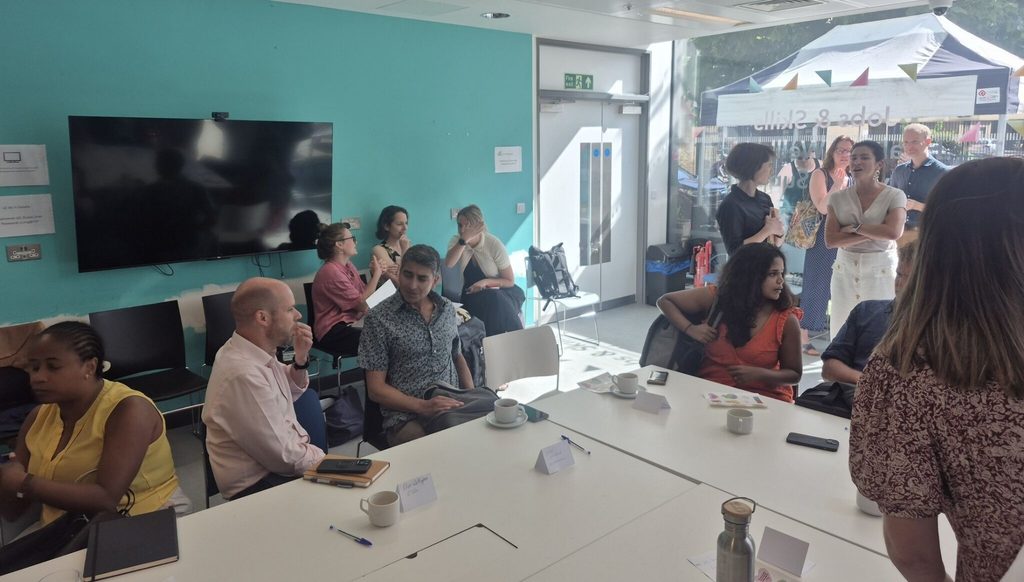
The opening discussion revealed just how differently people approached the issue. Some saw the expansion of AI infrastructure as inevitable, with the challenge being to shape it through better policy. Others questioned that premise altogether, arguing that a climate-aligned expansion is far from guaranteed. Some believed AI could make a meaningful contribution to climate action; others saw today’s systems as offering relatively little while consuming enormous political attention and material resources.
Making those differences explicit turned out to be important. If we begin from different assumptions, we’re almost certainly imagining different destinations. Any shared vision has to start by acknowledging that. Rather than a single vision, what emerged was a set of themes that kept resurfacing throughout the discussion.
Power and (re)distribution. Again and again, the conversation came back to who benefits and who bears the costs. AI depends on shared resources: energy, water, land, nature, and generations of accumulated human knowledge. If the benefits remain private while the costs are socialised, something fundamental has gone wrong. Questions of taxation, accountability, and the concentration of economic power sat at the heart of the discussion.
Speed, race, and fossil fuels. The dominant narrative is that everyone else is moving quickly, so slowing down is not an option. That ‘race’ logic makes almost any safeguard appear to be an obstacle. It also creates a powerful justification for using fossil-fuel infrastructure to meet rapidly growing demand. One question lingered throughout the discussion: does the race end when the money runs out, or can we shift it into a race we’d actually want to win?
Not all AI is the same. The current public discourse tends to lump different technologies into a single category. The machine learning systems that help forecast electricity demand or improve grid management are not the same as large generative AI models with vastly higher energy requirements. Treating them as equivalent makes it harder to distinguish genuinely valuable applications from those whose costs are much harder to justify.
The challenge isn’t only more regulation. In many cases, rules already exist. What is often missing is transparency, monitoring, and enforcement. There is still no widely accepted standard for measuring AI’s environmental footprint, which forces policymakers to rely on incomplete proxy data. Participants also raised concerns about weak corporate accountability and the need to apply expectations that already exist in other industries, like steel, including reporting environmental impacts and paying for externalities.
Public consent matters. The policy conversation is moving faster than public understanding. Many communities increasingly feel that AI infrastructure is happening to them rather than with them. Participants drew comparisons with fracking, where local opposition ultimately proved decisive in halting it in the UK. Data centres cannot assume a social licence to operate simply because planning permission has been granted.
Material limits remain real. Energy is only part of the story. Participants discussed looming shortages of critical minerals, growing interest in deep-sea mining, and the environmental and social impacts borne by communities supplying raw materials. The physical limits of the transition deserve as much attention as its digital ambitions.
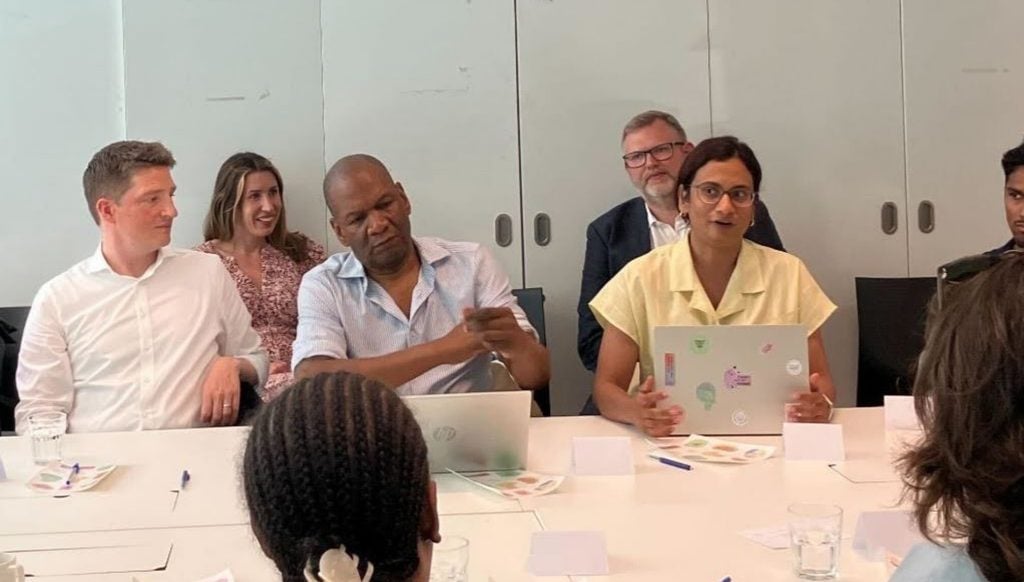
When we imagined 2030, the terms – and mood – shifted. In that future, we had started with the hard numbers. We measured the true footprint of the buildout across energy, water, land, food, and wildlife, and used that evidence to drive full environmental disclosure and fair taxation. But we had also led with our hearts. Reverence for nature sat at the centre, treated as the source of real joy – worth protecting for its own sake. Future leaders also took this up as a task beyond environmental compliance alone.
Most importantly, in that future, we had held on to our humanity, and with it more agency than the “bigger, faster, do more” narrative of the present allows. We had integrated AI more strategically than we assume today, and we had worked out how to better match which models are needed for which use case.
Tellingly, we didn’t imagine this future arriving because of a perfectly designed policy roadmap. Instead, a series of shocks got us there, big enough to mobilise people but small enough not to break us, along with the plain realisation that you can’t eat compute when the bread basket fails.
This was a room of thirty people, and arguably not everyone would sign up to every part of that picture. But it was a start. We are still some distance from a shared vision, but conversations like these can help us get one step closer. The work now is to keep talking, keep testing our assumptions, and keep building bridges, so that we end up working towards a future we want rather than one we fear.