
Challenging Europe’s assumptions about power and technology at Think & Do 2025
Can Europe be both sovereign and competitive in technology? Does it have genuine agency in shaping the global tech agenda? And what legacy will today’s choices leave for future generations? Can tech policy events in Brussels actually be exciting?
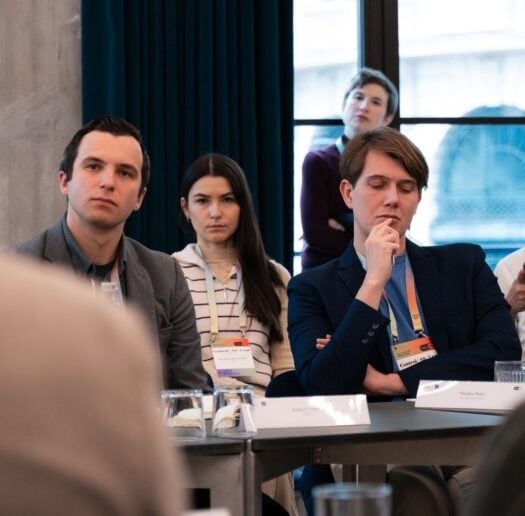
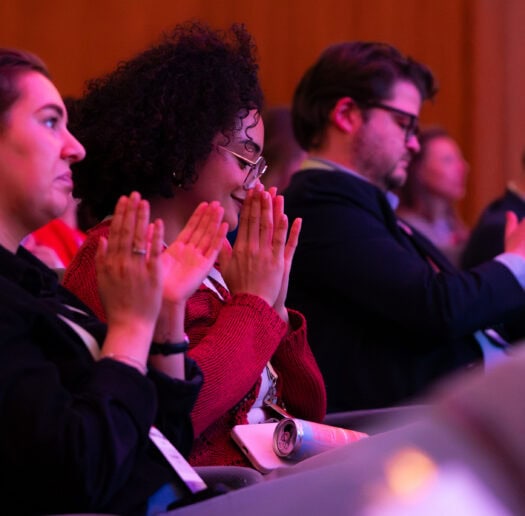
Over 250 participants gathered in Brussels on October 29 to wrestle with Europe’s most pressing technology governance challenges – and to move beyond diagnosis toward actionable pathways to a better future.
Europe at a crossroads
The event’s central question – “Control/Alt/Lead: Does Europe have a leadership role to play in global technology?” – captured a moment of acute uncertainty for the bloc. With geopolitical spheres of influence re-emerging and technological change accelerating, Europe faces a generational choice about its role in shaping humanity’s technological future.
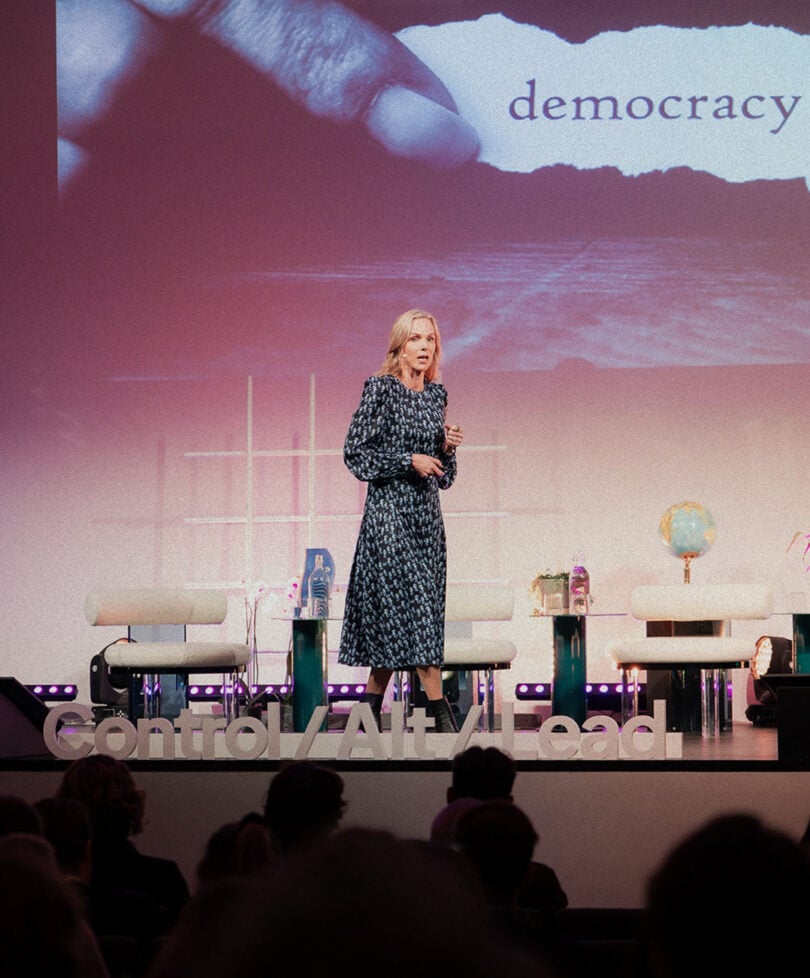
The day’s opening keynote from Anu Bradford, Professor at Columbia Law School and author of The Brussels Effect, set the frame:
- Anu began by establishing the high-stakes of this historical moment. The international order is changing rapidly – from trade to military alliances to liberal democracy itself – while the most powerful companies and nations on earth are racing for technological supremacy.
- Until now, the EU has relied on the old securities of a rules-based international system, NATO and transatlantic cooperation to underpin its digital policy agenda, which has resulted in flagship policies like GDPR, the DSA and DMA, as well as the AI Act (all of which can be tracked on our website here). Regardless of how one feels about that agenda, Europe now faces a choice about how to stay relevant: wait for political realignment in the West or embrace the challenge of developing and regulating new technologies.
- The Draghi report laid out this option in detail, but it got one critical thing wrong – the problem is not regulation. Lagging technology innovation and competitiveness in Europe long predates the regulatory agenda. In reality, Europe faces deeper and more structural challenges:
- A fragmented digital market. Different languages, polities, legal structures and divisive borders work together to raise barriers to scale. It is simply easier to reach hundreds of millions of customers in the US than in the EU – so that’s a good reason to scale there rather than here.
- Lack of capital market union. European tech start ups don’t have access to risk-friendly capital – as soon as European start ups need to scale, they turn to the US / silicon valley for funding.
- Legal and cultural barriers to risk taking. We have some of the most punitive bankruptcy laws in the world. This means that if companies go bankrupt, it’s very hard to start again. In the US, going through that cycle is much easier.
- Access to a global talent pool. Many founders are immigrants – this is something the US has got right (until recently). Without the right talent, innovation doesn’t happen.
- “This can be Europe’s sputnik moment,” Anu told the crowd. This, therefore, is a moment to elevate our ambition and creativity and to push for radical change – Europe’s peace and democracy depends on it.
Three provocations, one red thread
Think & Do 2025 structured the day around three interconnected themes, each designed to challenge assumptions about Europe’s technological trajectory.
Control: Geopolitical readiness requires technological readiness
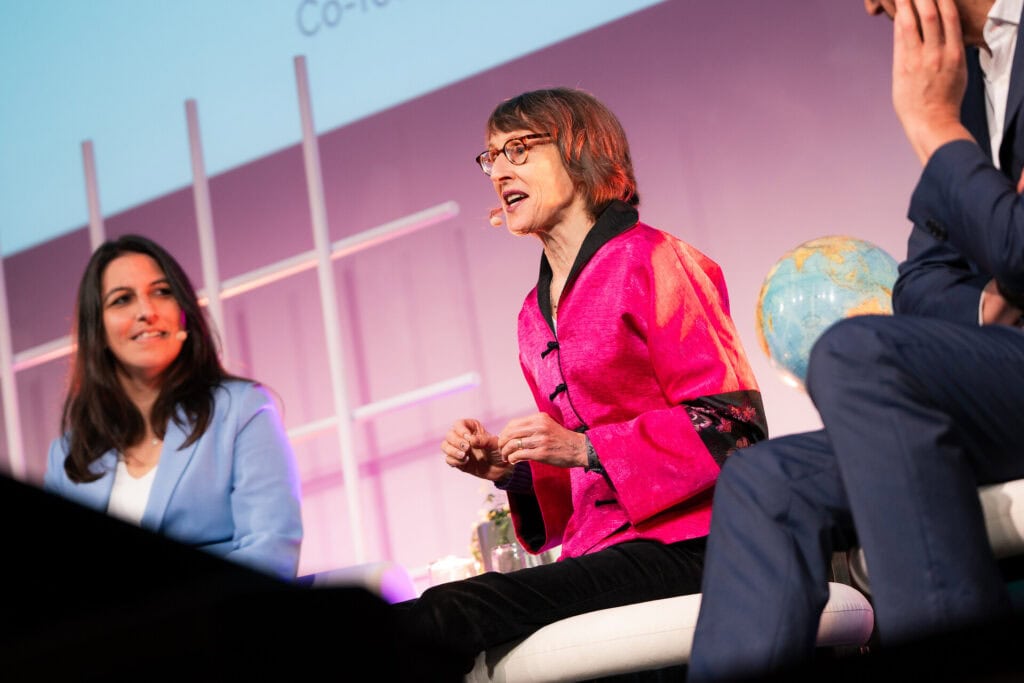
The morning plenary confronted an uncomfortable reality: Europe’s geopolitical ambitions increasingly rest on technological capabilities it doesn’t fully control. This session featured former Director of Top Sectors & Industrial Policy at the Dutch Ministry of Economic Affairs, Serpil Tascioglu, Managing Director, Vlaams Instituut voor Biotechnologie (VIB), Jérôme Van Biervliet, and CFG Senior Fellow, Cynthia Scharf. This plenary was moderated by Editor in Chief of The European Correspondent Julius E.O. Fintelmann.
The session explored which technological assets Europe can actually leverage – from its strong fundamental research ecosystem to holding key positions in the compute supply chain – and what it would take to move from reacting to setting the agenda. They explored the difference between regulation designed to constrain excesses and policy designed to harness latent potential – public sector intervention shouldn’t just , and encouraged EU leaders to be more responsive, both to coalitions seeking collective solutions but also to citizens initiatives and entrepreneurs who are trying to build European answers to our tech challenges.
Alt: The sovereignty-competitiveness dilemma

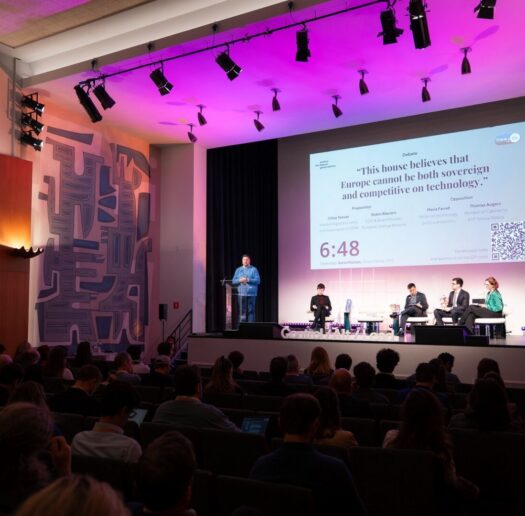
An Oxford-style debate tackled the motion “This house believes that Europe cannot be both sovereign and competitive on technology,” with teams of two taking up the proposition – Robin Wauters, Chief Operating Officer and Board Member, European Startup Network and Founding member of EU-INC, and Chloe Teevan, Head of Digital Economy and Governance, European Centre for Development Policy Management (ECDPM) – and the opposition – Maria Farrell, writer and tech policy expert, and Thomas Auger, member of EVP Theresa Ribera’s Cabinet.
While the motion itself was broadly disputed by participants during the day, the opposition did an excellent job making the case for hard trade-offs. “At some point,” Chloe Teevan began, “Europe is going to have to make decisions on the pressure from the Trump administration.” This spurred some spirited points about the realities of sovereignty in the kind of fractured and fractious world that Anu Bradford had introduced earlier in the day. There was some hope there, as Robin Wauters alluded to, as “entrepreneurs don’t care about sovereignty, they care about scaling businesses and getting talent.” The people designing technologies and creating businesses are looking for ways to cooperate and operate; geopolitics is something that is also happening to them. That’s an opening for European leaders willing to forge unlikely coalitions.
Maria Farrell from the opposition pointed out that any search for tech sovereignty requires an embrace of competition, because “competition means resilience while dependence means fragility.” This point was backed up by Thomas Auger who argued “trading away European values is a huge mistake – dropping values for competitiveness would mean losing on all fronts.” This echoed broadly felt sentiments from the audience that the task in front of European leaders was to find a European approach to tech rather than ape the examples of the USA or China.
Lead: Designing Brussels Effect 2.0

The closing plenary asked the hardest question of all: what should European leadership in technology actually look like?
Danish Presidency Cyber and Tech Diplomacy attaché Ann Sander Nielsen explained that a changing Brussels effect in a shrinking economy means Europe cannot and should not isolate itself by going it alone and sacrifice international collaboration in the name of sovereignty. Europe will need to hone in on its strengths and pick moonshots, maintaining R&D pipeline in strategic areas such as semiconductors, sovereign cloud, quantum and 6G to attract investment and build scale. Trust was identified as one of Europe’s most valuable and potentially measurable currencies for its digital economy. Trust could be built with an open minded open source approach to bridge global digital divides, encompassing open data spaces, interoperable standards and sustainability principles.
Gilberto Morishaw from the Creative Regenerative Futures Foundation highlighted an opportunity for the EU in foundational long-term governance based on democratic values and ethical excellence. European leadership would translate into follow-through on value-based agreements, even when these appear economically inconvenient in the short term: namely by applying more robust and comprehensive sanctions policies to countries contravening international law.
Sana Afouaiz , founder of the Womenpreneur Initiative, believes Europe’s leadership in technology needs to be more geopolitically responsive and responsible. Europe should see itself as the strategic centre of a global village, indexing on human capital from the bottom up as a key pillar of its economic competitiveness strategy. Rather than only thinking about importing top talent, Europe would turbocharge its economy by adapting its investment culture and stimulating entrepreneurship with “tech readiness” for women and in particular women immigrants, both statistically significant groups and underrepresented as tech creators and underserved as consumers in the tech economy.
CFG Senior Fellow Leonardo Quattrucci picked up on Europe’s strategy for talent as essential to demonstrating tech leadership. More “institutional mathematics”and geopolitically smart leadership would result in a response plan to the US’s recent decision to revoke H1-B visas. False dichotomies such as values versus competition don’t address the real issues preventing EU tech start-ups from scaling in Europe – European leadership would mean importing engineering capacity and a confident posture of competing because of our values rather than in spite of them.
Beyond the Bubble
Four afternoon workshops dug deeper into specific challenges:
- Geopolitics of AGI, co-hosted with RAND Europe: It was standing room only at this roundtable, as discussions centered on how Europe can safeguard its democratic values and strategic autonomy without falling behind global AI leaders. Participants explored the implications of shifting transatlantic relations and emphasized the need for more ambitious European leadership to shape AI governance and defense policy.
- Who gets to dim the sun?: A workshop exploring the governance needs and tensions around possible yet highly problematic deployment scenarios of solar radiation modification technologies in 2035. A highly polarising topic, this session prompted a reflection on the nuances and complexities of what is too often taken as a very black-or-white issue.
- Mind the future: The workshop session began with a guided tour of neurotechnology’s evolution, from its medical roots to its increasingly widespread, rapidly-approaching consumer adoption. Participants reacted to a series of plausible near-future scenarios before stepping into the roles of users, patients, clinicians, developers, caregivers, and regulators. Together they explored areas of agreement and friction among these stakeholders and crafted policy ideas aimed at ensuring neurotechnology serves human flourishing and ethical innovation.
- How faster science could build a secure future: This workshop proved that speed can save lives: Newton Wahome from the Coalition for Epidemic Preparedness Innovations (CEPI) demonstrated how AI could revolutionize Europe’s pandemic response, followed by a live demonstration of CFG’s “Virtual Lab” showing AI scientists collaborating to accelerate vaccine design in real-time. Participants then put theory into practice, mapping acceleration pathways for Europe’s biggest security and prosperity challenges.
One thing that came across from all these sessions was the desire to get information out into open or common platforms so a whole range of stakeholders – be they citizens, policymakers, industry associations, NGOs and many others within the EU or, indeed, the plethora of people in the rest of the world looking to the EU for first reactions – can first understand and then weigh in on how we respond to these transformative ideas.
Interestingly enough, this is one of the challenges that CFG was originally designed to address. Emerging tech, by its very nature, is obtuse to all but a handful of people, very often the ones creating that technology; if policymakers are going to govern them effectively they will need independent experts to help them navigate the technology – or else they will have to turn to experts with vested interests in their decisions. Enter, CFG.
Tackling this information asymmetry is still core to our mission, but it goes far beyond one organisation – this is about creating governance structures that prevent individual companies from accruing a monopoly on relevant information.
The questions that remain
Think & Do 2025 didn’t offer easy answers – our approach rarely does. Instead, it provided what policymakers need most: rigorous analysis of trade-offs, clear articulation of choices, and an honest assessment of what different pathways might mean for future generations.
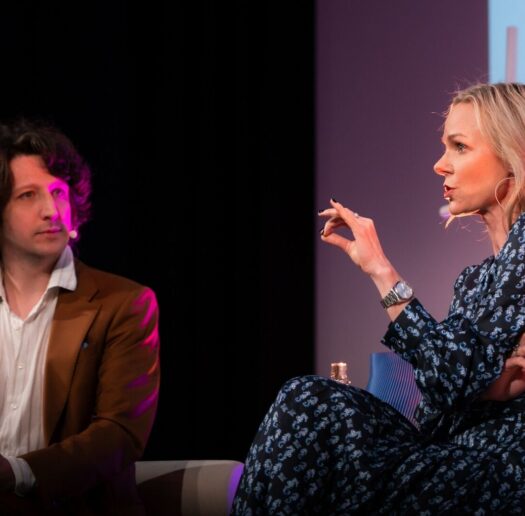
As stated during the final fireside chat with OECD’s Senior Counsellor for Strategic Foresight, Rafał Kierzenkowski, “uncertainty is the new normal” – we have to be clear eyed about the challenge in front of us.
Europe has been in a reactive mode for too long, rushing from one crisis to another in search of quick wins and unlikely last minute solutions, but the reality is that this only sets us up for further disruption. This is why CFG puts foresight techniques at the heart of our work – to make the shift to anticipatory governance approaches, we have to get policymakers engaged in long-term thinking. As Rafał noted, “It’s tempting to seek quick wins. But real resilience comes from preparing for multiple plausible futures, not just reacting to the present. That’s where foresight comes in.”
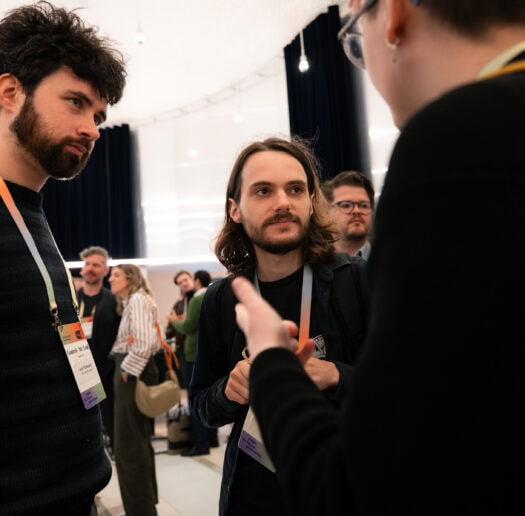
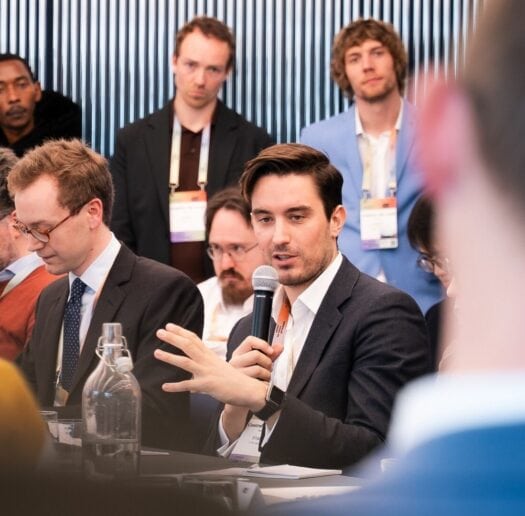
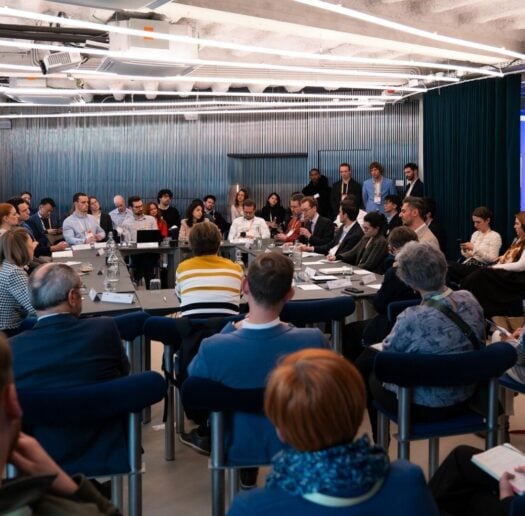


As participants dispersed into the Brussels evening, the feedback boards told their own story. Events like these are really made by what the participants bring to it, the conversations in hallways and over food, the debates sparked by the agenda. The onstage agenda is just the starting point. When asked “What does successful tech leadership in Europe look like to you?”, responses included: “Courage and collaboration”, “…human-centric and reflecting our values”, “…a multi-stakeholder approach…”, “Don’t be afraid of the big bad tech”, and, one of our favorites, “Multiplicity – Know who you are, what you can offer, what makes you unique. There is no one way”.
Think & Do 2025 proved that Europe has no shortage of ideas about its technological future – what it needs now is the institutional courage to act on them. CFG will be following up on each breakout session and continuing specific workstreams with participants, from our work with RAND Europe on the geopolitics of AGI to the SAFEGEOGOV scenario project we launched at the event. Video highlights will be available in the coming weeks at cfg.eu as well as full recordings of onstage sessions on our Youtube channel.
The conversations started in Brussels need to continue in capitals, boardrooms, and communities across Europe. The future belongs to all generations, and the choices we make now will determine whether they inherit a Europe that shapes technology or is shaped by it.
Please stay in touch as we look to 2026 and beyond – you don’t want to miss invitations for the next Think & Do!